Inspired by this blog post (Detecting hoaxshell with Wazuh | Wazuh) by the Wazuh team, I decided to look at how easy it would be to create a detection and response tactic for PowerShell based payloads used as droppers or for command and control. Some typical attack patterns we would be interested in detecting:
VBA macro à PowerShell command à Download RAT à Install
User action or dropper à PowerShell reverse shell
Common to both these PowerShell use cases, is that a PowerShell command connects to a location on the network (internal or Internet). In addition, we may detect obfuscated payloads, such as Base64 encoded scripts.
Wazuh has a number of detection rules by default, but Windows is not logging PowerShell script blocks by default. You can enable these logs using several methods, for example GPO’s, or doing registry edits. Here’s a recipe for turning it on: about Logging – PowerShell | Microsoft Learn. Note that on Windows 11 Home, gpedit.msc is not installed by default, but you can still enable PowerShell auditing using a registry key.
Note that all of these reverse shell payloads are automatically blocked by Defender, so if you want to test if Wazuh can detect them you need to turn off defender, or obfuscate them further. Currently we are not trying to be very ambitious, so we only want to detect basic reverse shells without further obfuscation.
There is no rule for this type of reverse shell detection. However, we are collecting PowerShell commands from the client, so we should be able to create a new local rule on the Wazuh manager.
Adding the following rule:
We then restart the Wazuh manager with “systemctl restart wazuh-manager”, and now we are ready to try our reverse shell. First, we try without turning off Windows Defender, then we turn it off, and try it again. Then we succeed establishing a reverse shell, and it is immediately visible in Wazuh.
Expanding the alert in Wazuh, we see that the full script block is extracted by the decoder.
This is very helpful in an incident response situation, also if the payload is obfuscated, as we have a starting point for reversing it and extracting indicators of compromise.
Wazuh has the capability of running active response scripts. These are scripts that are run on a client when a certain rule is triggered. None of these are active by default, but Wazuh ships with a few rules that can be enabled. The default scripts that can be enabled on a Windows endpoint are:
Block IP address, either using netsh to block it on the Windows firewall, or using a null route.
Restart the Wazuh agent
You also have the capability to create custom response scripts. We could extract the IP address from the PowerShell operational log, or we could kill the PowerShell process itself. Both of these are risky, if we are not very confident that the process is malicious. Of course, when the detection is simply based on the fact that a new TCP connection was created by PowerShell, we have not way of really knowing that. For that we would need a much more specific detection, preferably matching clear indicators of compromise. Wazuh does not have a live response feature, like many commercial EDR products. An alternative approach is to install a remote access tool on each endpoint, allowing the analyst to connect and perform live response on the device itself.
In other words, to perform remote response in this situation, either create more specific detections, or provide a tool to do it manually on the endpoint. But all in all, Wazuh rules are relatively easy to customize, and you can map your own rules towards a threat model. You can also tag the rules you create with the relevant MITRE ATT&CK technique, which brings a bit more context in the Wazuh dashboards.
After updating the new detection rule with MITRE technique, we get a bit more context into the Wazuh alert. We can then easily use MITRE ATT&CK techniques in threat hunting, and to categorize detections.
Privacy receives a lot of attention in public, but within the enterprise it always takes a back seat to security. We seem to be protecting the interests of the corporation by throwing fine masked surveillance net over the employees. There is rarely much discussion or openness about what telemetry companies collect and analyse in the name of security, and how this affects people’s ability to work together, trust each other, and collaborate creatively.
In some corporate environments the creation of a surveillance culture can lead to an almost adversarial relationship between the information security team and the rest of the company. If people feel watched, and treated like threats, they tend to not like the watchers very much.
Authenticity, logic and empathy are key factors of trust, according to psychologist Liane Davey being interviewed in HBR podcast HBR On Leadership – Episode 33. Often, one or more of these components are lacking in security communications within the enterprise.
Authenticity can be seen as something one has, when one is clear about the intentions of doing something, and transparent about both viewpoints, and true to one’s values. If an organization talks a lot about inclusion being important, that transparency is a key value, and that respect for individuals are high on the agenda, this may seem quite inauthentic if at the same time people are met with strict security policies, and draconian measures with no reasoning beyond “because of security we need to do X”. This is unfortunately a quite common approach to communications about security, often followed by an excuse to not explain things because secrecy is necessary for everything that has to do with security. If you get in this “us vs. them” situation, you are quite unlikely to be trusted when you do have something to share. In companies like this, people see security as an element of friction, and the security team’s favorite meme is always dumpster fire themed.
The next piece of this puzzle is logic. There is often a form of logic behind security measures. The reason something is done, is usually to stop data breaches, cyber attacks, or insider threats. The goal sometimes seems to be to stop incidents from happening, at any cost. From an isolated point of view, where the security goal is to be as secure as possible, this makes sense. But in the real world, the goal of security should not be to be secure for the sake of some security deity demanding absolute adherrence to IT security policy; it should be to reduce the risk of cyber threats posing an unacceptable risk to the ability of the businss to achieve its mission. And to do that, the business needs people.
The isolated “security deity logic”, let’s call it SDL for short, is at odds with the emptathy pillar of trust. Draconian measures will cause friction in people’s workdays, and a feeling of constant surveillance likely has a number of negative effects on the flow of ideas and the creativity of the organization as a community of colleagues. The conversation is diminished through a feeling of living in a surveillance state. Technical controls often make people go through inconvient processes to get work done. While locking down access to files to only a few people (good practice according to the holy security gods – the least privilege principle) will make it harder for an attacker to steal data, it will also make it harder for other colleagues to find and learn from what has been done in previous projects. By adding a heavy process for vetting software vendors can potentially reduce the risk of a supply-chain attack, it can also drive employees to run their jobs out of personal cloud accounts – just to get things done. If the logic of security architecture is applied in the wrong context (SDL), you end up not taking the needs of people in the organization into account. Because their needs and their logic, that is aligned with the business strategy, are different than the logic of SDL.
What is common in terms of enterprise monitoring?
The typical approach to security today is a 3-step process:
Create rules for what is allowed and what is not.
Lock down technology.
Monitor everything and report any “anomaly” to security team
All of this is actually necessary, but it should be designed with the needs of the business in mind, and not take the SDL approach.
Security monitoring today usually relies on agents on end user machines – socalled EDR or XDR agents. These are antivirus on steroids, with some extra capabilities that resemble a lot of what the actual malware will do, such as controlling the computer remotely. In addition to these agents, the network is typically monitored. This means that everything you do on this network is registered, and can be tied back to the machine used, and the user account used. In addition, with modern cloud services such as Office 365, the activity in these products will often be monitored too.
This monitoring will make a lot of very detailed informaiton avilable to the IT department. Such as:
When you logged on, and where you logged on from
All programs you are running on your computer, and when
All files accessed
All links clicked
All websites visited
All emails and Teams messages sent and received
These tools will normally not break end-to-end encryption, or even TLS (but some do). An nobody is (or should be) actively using this to track what you are doing, like reporting to your boss if you are spending too much time watching cat videos on YouTube instead of logging new leads in the CRM, but the ability to do so is there. Depending on the threat model of the company, all of these measures may be necessary, and they do make it possible to detect actual attacks and stop them before unnecessary harm is done. But: the technology should be used responsibly, and there should be a proportionality of the risk reduction achieved and the impact to privacy it incurs. An above all – there needs to be a certain level of transparency. It is understandable that you don’t want to talk openly about exactly how you monitor your environment, because it would definitely help a targeted attacker. But this does not mean that everything that has to do with security needs to be secret. If you want to look at some examples of data collected for different systems, vendor documentaiton pages would be a good place to start. However, the full privacy impact comes from the combination of multiple tools, and how the data is being used. Here are some links to documentation that shows some of the capabilities that are useful for security, but would also make Felix Dzerzjinskij optimistic about capitalism.
So how can the security team avoid becoming a digital KGB within the enterprise? I think 3 good principles can help us achieve the right balance.
Security is a business support function. Align security goals with company mission and strategy.
Make security architecture balanced. Take the organization’s way of working into account, its risks and risk apetite, and the needs of people working there. Don’t use security deity logic (SDL).
Build trust through authenticity, logic and empathy. Be honest, also when you cannot share all details, use the right context for the logic, and show real empathy for people in other roles in the organiastion.
If we manage to do this, we will get less turf wars, and better alignment of security and business objectives. And who should be responsible for making this happen? That’s clearly a top leadership responsibility.
The other day I listened to the Microsoft Threat Intelligence Podcast on my way to work (Spotify link). There they mentioned that the threat actor “Peach Sandstorm” had used Azure Arc as a persistence vector, but not giving much detail about how this would work. This rather unusual technique can be a bit hard to spot, especially on Linux hosts, unless you know where to look. The log file /var/opt/azcmagent/log/hidms.log is a good place to start (if it exists and you are not using Azure Arc, you may be in trouble).
I got a bit curious, so I decided to how that would work, and what kind of logs it would generate on the host (without any extra auditing enabled beyond the default server logs).
Arc Agent on Linux Server
For the first test I used a Linux VM running in Google Cloud. Then I used the Azure portal to generate an install script for a single server.
To install the agent, I ran the script on the VM, and had to authenticate it by pasting a code generated in the terminal in a browser window. After this I was able to to connect to the VM from the Azure portal. Depending on what extension you install, there are multiple options for authenticating, including using Entra ID. I chose not to install anything extra, and added a public key to the VM, and then provided the corresponding private key to the Azure portal, to connect using plain SSH from an Azure Cloud Shell.
Detecting this connection is not straightforward, as Azure Arc sets up a proxy. Running the last command will only show a login from ::1, so it is not so easy to see that this is coming from an external attacker. If you try to use netstat to see live connections, it is also not immediately clear:
tcp 0 0 10.132.0.2:22 35.235.240.112:45789 ESTABLISHED 766092/sshd: cyberh
tcp6 0 0 ::1:22 ::1:36568 ESTABLISHED 766163/sshd: cyberh
The top connection here was from the Google cloud shell, and the bottom one was the Azure Arc logon.
Since Linux logs sudo calls in the /var/log/auth.log file, we can see the installation commands being run:
Oct 23 07:56:33 scadajumper sudo: cyberhakon : TTY=pts/0 ; PWD=/home/cyberhakon ; USER=root ; ENV=DEBIAN_FRONTEND=noninteractive ; COMMAND=/usr/bin/apt install -y azcmagent
Oct 23 07:56:33 scadajumper sudo: pam_unix(sudo:session): session opened for user root(uid=0) by cyberhakon(uid=1000)
Oct 23 07:57:02 scadajumper sudo: cyberhakon : TTY=pts/0 ; PWD=/home/cyberhakon ; USER=root ; COMMAND=/usr/bin/azcmagent connect --resource-group quicktalks --tenant-id adf10e2b-b6e9-41d6-be2f-c12bb566019c --location norwayeast --subscription-id 8a8c2495-4b8c-4282-a028-55a16ef96caa --cloud AzureCloud --correlation-id fc67cc2f-7c66-4506-b2cf-2fe8cf618f25
If you suspect that an Arc agent has been installed, you can thus grep for “azmagent” in the auth.log file. From the last log line here we have quite a lot of data that helps us with attribution.
You also get the resource group and the Azure location used by the attacker
Another way to find this installation is to have a look at the running services.
systemctl list-units | grep -i azure
azuremonitor-agentlauncher.service loaded active running Azure Monitor Agent Launcher daemon (on systemd)
azuremonitor-coreagent.service loaded active running Azure Monitor Agent CoreAgent daemon (on systemd) loaded active running Azure Monitor Agent daemon (on systemd)
himdsd.service loaded active running Azure Connected Machine Agent Service
The himdsd.service is the service running the Arc agent. Overview of the Azure Connected Machine agent – Azure Arc | Microsoft Learn. In the documentation for the Azure Arc agent, we learn that there are log files generated in multiple non-standard locations. Performing an SSH-based login with private key from Azure Cloud Shell, we find the following lines in the log /var/opt/azmagent/log/hidms.log:
This log contains quite a lot of interesting inforamtion. If you want to search the log file for interesting events, grepping for “Connect Agent” is a good start.
Arc Agent on Windows server
When we try the same thing on Windows, it is a bit more obvious in sign-in events, because the authentication using the agent still generates Event ID 4624, and also shows SSH as the sign-in process.
In this case, we created a new username “hacker”, and used this to log in from Azure Arc in the portal, using hte Azure cloud shell. We see that the Logon Process is reported as sshd. On Windows this is easier to discover, as SSH is not commonly used for remote access. In fact, the SSH server is not installed by default, so we had to install it first, to make this technique work for remote access.
Also, when being logged in with GUI access, the Azure Arc agent will stand out both in the Start menu after being installed and in the list of installed applications. This test was run on a Windows Server 2022 running on an EC2 instance in AWS.
If you are not using Azure Arc yourself, and you see the “Azure Connected Machine Agent” among installed apps, there is reason to investigate further!
In summary
In summary, using Azure Arc as a persistence vector is interesting. On Linux it is more stealthy than on Windows, largely because of the localhost reference seen in the last log, whereas on Windows Event ID 4624 with sshd as logon process is typically reason to be skeptical.
The technique, when used as shown here, will leave traces of the Azure tenant ID and subscription ID, which can be used for attribution. On Linux it is interesting to note that the most useful log data will not be found in the /var/log folder, but in /var/opt/azmagent/log instead, a location where most defenders would quite likely not look for bad omens.
I have not been feeling well the last few days, and taken some sick days. The upside of that is time on the coach researching stuff on my laptop without needing to be “productive”. Yesterday I did a dive into the History file in Edge, looking at how URL’s and browser history is saved. Today I decided to continue that expedition a bit, to look into the downloads history, as well as search terms typed into the address bar.
Downloads – when did they happen?
Sometimes you would like to investigate which files have been downloaded on a computer. A natural way to do this is to look in the downloads folder of the user. However, if the files have been deleted from that folder, it may not be so easy to figure out what has happened. A typical malware infection could be to trick someone into downloading a malicious file and then executing it.
If we again turn to the History file of Edge, we can check out the downloads table. It has a lot of fields, but some of the interesting ones are:
id
target_path
start_time
tab_url
Immediately interesting property for forensics investigations is that we can check with start_time when the download occurred. We also have access to the URL of the download, from tab_url, as well as where it was linked from.
To test how well this works, I am going to download a file to a non-standard location.
select id, tab_url, target_path, datetime(start_time/1000000 + (strftime('%s','1601-01-01')),'unixepoch','localtime') from downloads;
This means that I downloaded the file from a Mastodon post link, but this is not the origin of the file.
It seems we are able to get the actual download URL from the downloads_url_chain table. This table seems to have the same id as the downloads table.
sqlite> select id, tab_url from downloads where id=6;
6|https://snabelen.no/deck/@eselet/111257537583580387
sqlite> select * from downloads_url_chains where id=6;
6|0|https://www.hubspot.com/hubfs/HubSpot%202023%20Sustainability%20Report_FINAL.pdf
Then we have the full download link.
In other words, we can based on these tables get:
When the download occurred
Where it was stored on the computer
What page the link was clicked on
What the URL of the downloaded file was
That is quite useful!
Searches typed into the address bar
The next topic we look at is the table keyword_search_terms. This seems to be the keywords typed into the address bar of the Edge browser to search for things. The schema shows two column names of particular interest: url_id, term. The url_id only gives us the ID from the urls table, so we need to use an inner join here to find the actual search string. Here’s an example:
sqlite> select term, url_id, url from keyword_search_terms inner join urls on urls.id=keyword_search_terms.url_id order by id desc limit 1;
Going through someone’s search terms is of course quite invasive, and we should only do that when properly justified and with a sound legal basis. Here are some situations where I think this could be helpful and acceptable:
There has been an insider incident, and you are investigating the workstation used by the insider. Probably still will require that the end user is informed, perhaps also concent, depending on the legal requirements at your location
An endpoint was compromised through a malicious download, and the link to the download came from a search engine. The attacker may have used malicious search engine optimization to plant malicious links on a search engine page
Here’s a potential case where you may want to have a look at the search terms. A user downloaded a malicious document and executed it. When investigating, you found out that the link came from a search engine result page. You would like to check the searches done that led to this page, as the malware may have been targeting specific searches to your business or business sector.
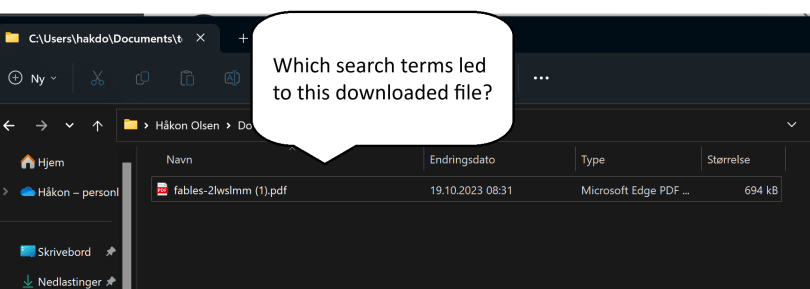
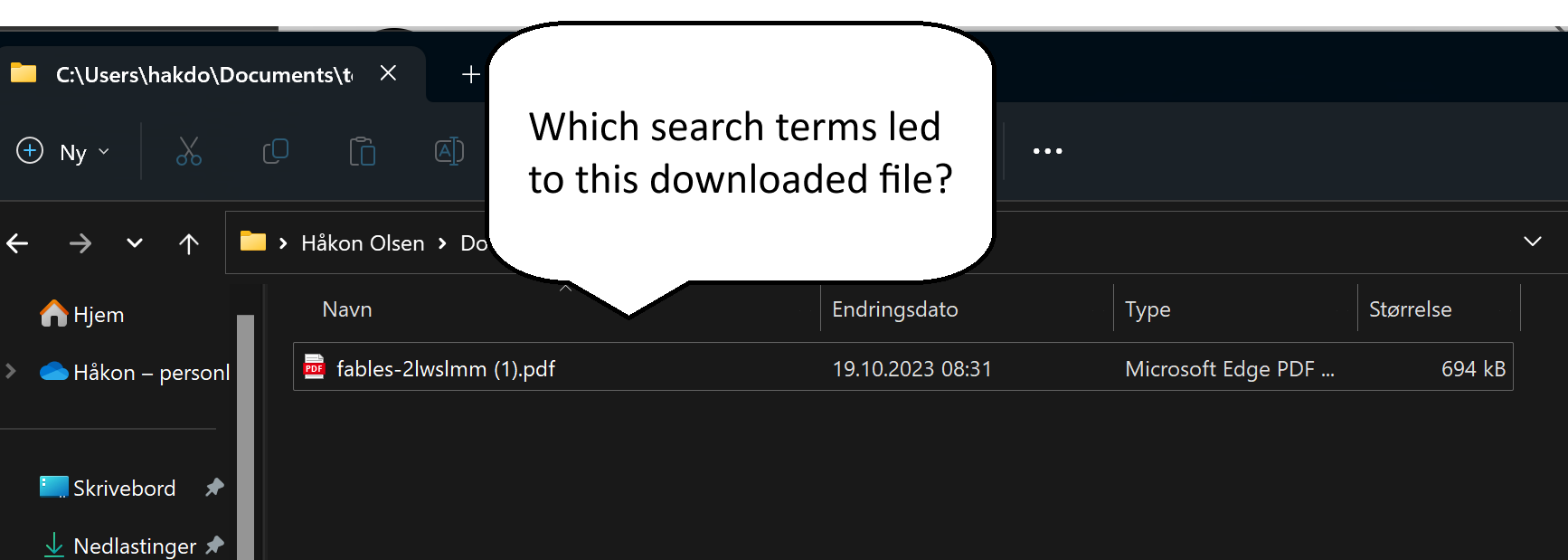
For the sake of the example I now changed the default search engine in Edge from Bing to Duckduckgo. Then I did a search and downloaded a PDF file directly from the search results. Using an SQL search to find the latest download we get:
sqlite> select id, tab_url, target_path, referrer from downloads order by id desc limit 1;
Now we know already here what has been downloaded. We can also see from the query string above what the search terms were (“evil donkey” and “filetype:pdf”). If we have reason to believe that the attacker has poisoned results relating to evil donkey searches, we may want to look at the searches done by the user.
sqlite> select * from keyword_search_terms where term like '%donkey%';
5|819|evil donkey filetype:pdf|evil donkey filetype:pdf
5|820|evil donkey filetype:pdf|evil donkey filetype:pdf
That is one specific search – if searching for “evil donkeys” is something that this company could be expected to do, but would in general be very unusual (I suspect it its), this could be an initial delivery vector using malicious SEO.
Note that the default behavior in Edge is to open a PDF directly in the browser, not to download it. In this case, the search engine URL would not show up as referrer in the downloads record, but the direct link to the document on the Internet.
The second column in the result above is a reference to the ID in the urls table, so more information about the search performed (including time it was executed) can be found there. For example, if we want to know exactly when the user searched for evil donkeys, we can ask the urls table for this information.
select datetime(last_visit_time/1000000 + (strftime('%s','1601-01-01')),'unixepoch','localtime') from urls where id=819;
The answer is that this search was executed at:
2023-10-19 08:31:28
I hope you enjoyed that little browser History file dissection – I know a lot more about how Edge manages browser history data now at least.
Note that there are forensics tools that will make browser history forensics easy to do. This is mostly for learning, but for real incident handling and forensics using an established tool will be a much faster route to results!
Basics
The edge browser history is stored in a sqlite3 database under each user profile. You find this database as C:\Users\<username>\AppData\Local\Microsoft\Edge\User Data\Default\History
The “History” file is a sqlite3 database, and you can analyse the database using the sqlite3 shell utility, that can be downloaded from here: SQLite Download Page.
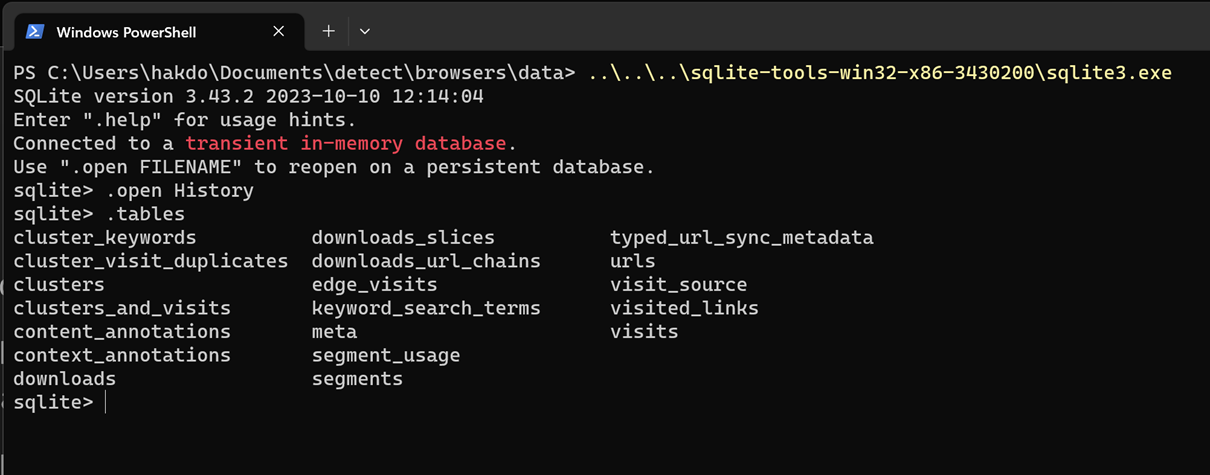
If we list the tables in the database, we see there are quite a few.
Several of these seem quite interesting. The “urls” table seems to contain all the visited URL’s that exist in the browser history. Looking at the schema of this table shows that we can also here see the “last visited” timestamp, which can be useful.
sqlite> .schema urls
CREATE TABLE urls(id INTEGER PRIMARY KEY AUTOINCREMENT,url LONGVARCHAR,title LONGVARCHAR,visit_count INTEGER DEFAULT 0 NOT NULL,typed_count INTEGER DEFAULT 0 NOT NULL,last_visit_time INTEGER NOT NULL,hidden INTEGER DEFAULT 0 NOT NULL);
CREATE INDEX urls_url_index ON urls (url);
It can also be interesting to check out the visit_count. For example, in the history file I am looking at, the top 3 visited URL’s are:
sqlite> select url, visit_count from urls order by visit_count desc limit 3;
https://www.linkedin.com/|24
https://www.linkedin.com/feed/|15
https://www.vg.no/|14
Another table that is interesting is, “visits”. This table has the following fields (among many, use .schema to inspect the full set of columns):
url
visit_time
visit_duration
The visits table contains mostly references to other tables:
sqlite> select * from visits where id=1;
1|1|13341690141373445|0||805306368|0|0|0|0||0|0|0|0|1|
To get more useful data out of this, we need to use some join queries. For example, if I would like to know which URL was last visited I could do this:
select visit_time, urls.url from visits inner join urls on urls.id = visits.url order by visit_time desc limit 1;
13342089225183294|https://docs.python.org/3/library/sqlite3.html
So.. at what times did I visit the Python docs page? The good news is that sqlite3 contains a datetime function that allows us to convert to human readable form directly in the query:
sqlite> SELECT
...> datetime(visit_time / 1000000 + (strftime('%s', '1601-01-01')), 'unixepoch', 'localtime'), urls.url
...> FROM visits
...> INNER JOIN urls
...> ON urls.id = visits.url
...> WHERE
...> urls.url LIKE '%python.org%'
...> ORDER BY visit_time DESC
...> LIMIT 3;
2023-10-18 09:53:45|https://docs.python.org/3/library/sqlite3.html
2023-10-17 10:01:54|https://docs.python.org/3/library/subprocess.html
2023-10-17 09:58:51|https://docs.python.org/3/library/subprocess.html
Making some scripts
Typing all of this into the shell can be a bit tedious and difficult to remember. It could be handy to have a script to help with some of these queries. During incident handling, there are some typical questions about web browsing that tend to show up:
When did the user click the phishing link?
What files were downloaded?
What was the origin of the link?
If we now try to make a small Python utility to figure out when a link has been visited, this could be a useful little tool. We concentrate on the first of the questions above for now – we have a URL, and want to check if it has been visited, and what the last visit time was.
Consider a hypothetical case, where we know that a user has visited a phishing link from his home computer, and that this led to a compromise, that later moved into the corporate environment. The user has been so friendly as to allow us to review his Edge history database.
We know from investigation of other similar cases that payloads are often sent with links to Pastebin content. We therefore want to search for “pastebin.com” in the URL history.
We copy over the History file to an evidence folder before working on it (to make sure we don’t cause any problems for the browser). It is a good idea to document the evidence capture, with a hash, timestamp, who did it etc.
Then we run our little Python script, looking for Pastebin references in the urls table. The command we use is
python phishtime.py History pastebin.com 2
The result of the query gives us two informative lines:
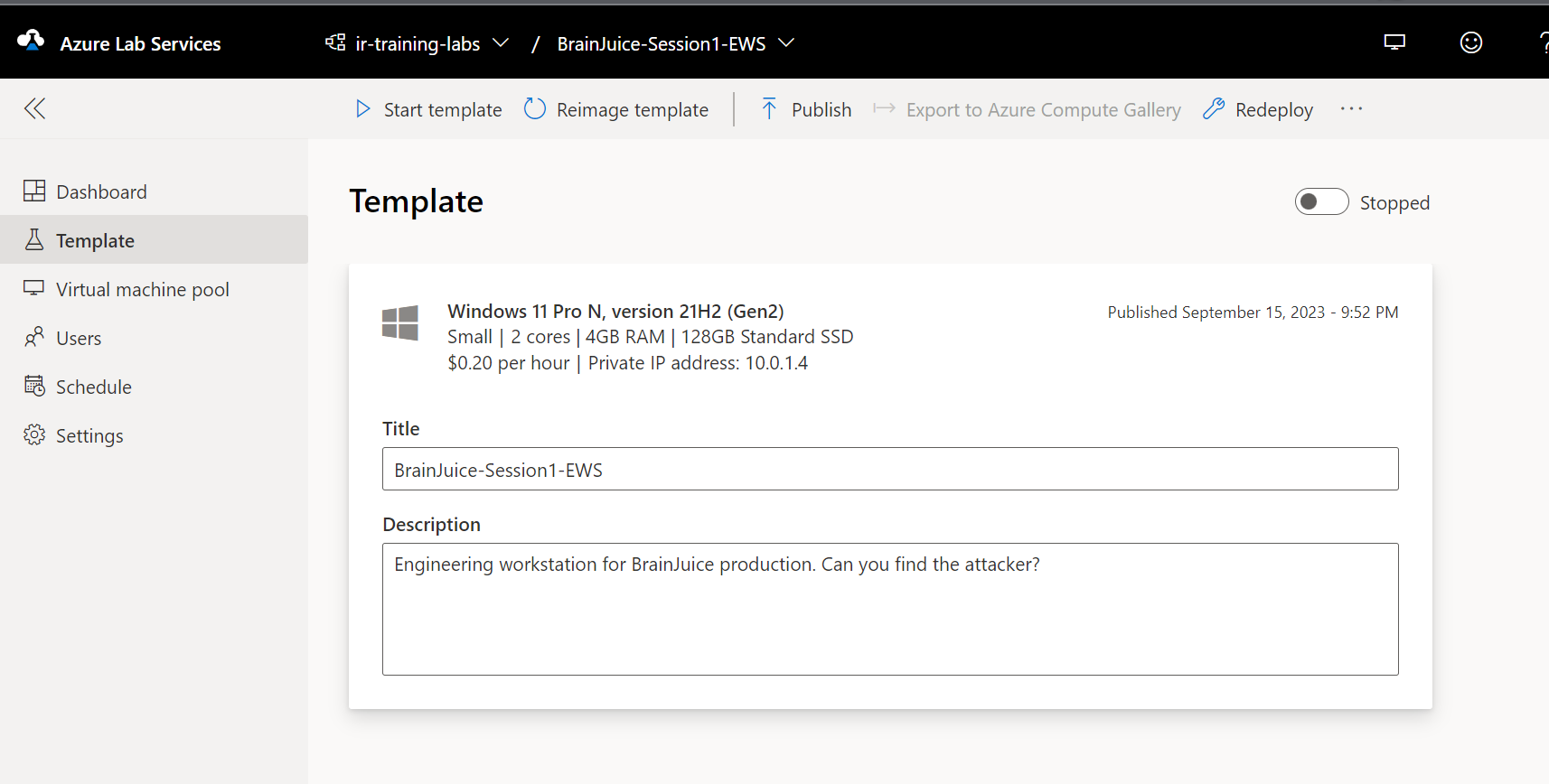
I have been planning an internal incident response training at work, and was considering how to create environments for participants to work on. At first I was planning to create some VM’s, a virtual network, etc., and export a template for easy deployment by each participant. The downside of this, is complexity. Not everyone is equally skilled with cloud tech, and it can also be hard to monitor how the participants are doing.
While planning this I came across Azure Labs. This is a setup to create temporary environments for training, replicated to multiple users. Looks perfect! I started by creating a lab, only to discover that it did need a bit more of config to get it working.
The scenario is this: a Windows machine works as an engineering workstation in a network. A laptop in the office network is compromised. RDP from the office network to the OT network is allowed, and the attacker runs an nmap scan for host discovery after compromising the office host, and then uses a brute-force attack to get onto the engineering workstation. On that machine the attacker establishes persistence, and edits some important config files. The participants will work as responders, and will perform analysis on the compromised engineering workstation. They should not have access to the office computer.
The first lab I created by just clicking through the obvious things, with default settings. Then I got a Windows 11 VM, but it had no internal network connectivity. After searching for a way to add a subnet to the lab, I found this article: Create lab with advanced networking. The summary notes are as follows:
Create a new resource group
Create a Vnet + subnet
Create a network security group
Associate the subnet with Azure labs
Create a new lab plan and choose “advanced networking”
Ready to create new labs!
With all this in place we could create a new lab. We need to choose to customize the VM to prepare the forensic evidence. We can run it as a template, and install things on it, do things to it, before we publish it to use in a training. This way we will have disk, memory and log artifacts ready to go.
If we want ping to work (and we do), we also need to change the Windows firewall settings on the VM, because Azure VM’s block pings by default. Blog post with details here. Tl;dr:
If you want to allow ping to/from the Internet, you will also have to allow that in the network security group. I don’t need that for my lab, so I didn’t do that.
We also needed an attacker. For this we created a new VM in Azure the normal way, in the same resource group used for the lab, and associating it to the same Vnet. From this attacker, we can run nmap, brute-force attacks, etc.
Then our lab is ready to publish, and we can just wait for our training event to start. Will it be a success? Time will show!
If you Google “how to add login to a Google Site” you get many hits for questions and few answers. I wondered if we could somehow create a Google Site with access control for a “member’s area”. Turns out, you can’t really do that. We can, however, simulate that behavior by creating two sites, where one contains the “public pages” and another one the “private pages”.
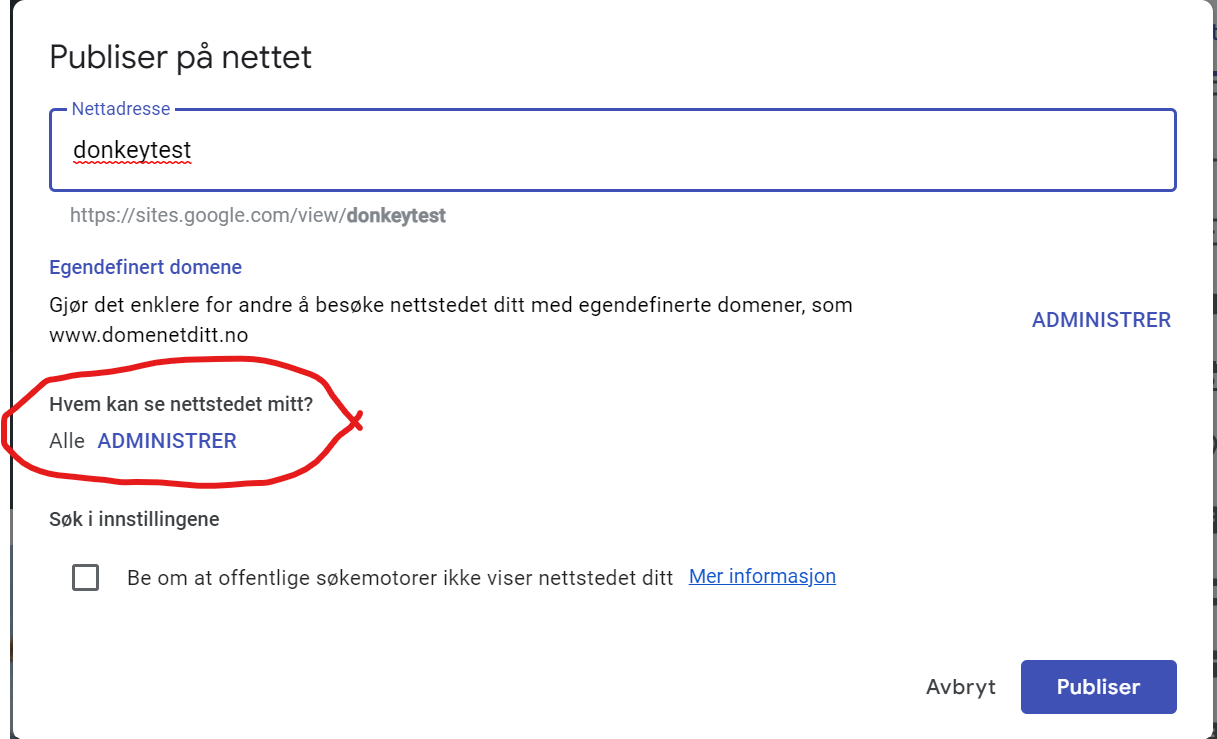
First, we create a site that we want to be public. Here’s an example of a published Google Site: https://sites.google.com/view/donkeytest/start. We publish this one as visible for everyone.
Publish dialog (in Norwegian) – showing access for all for our public page.
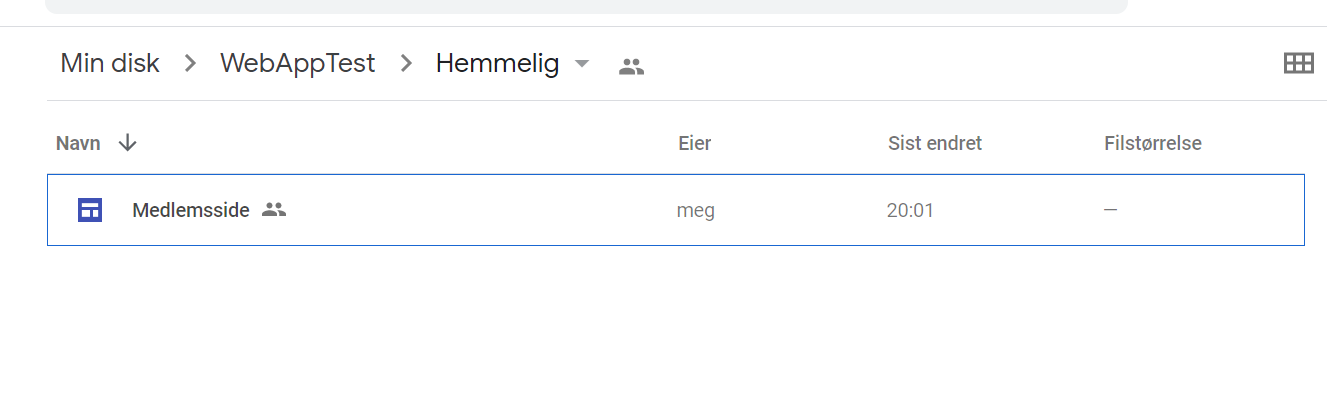
Now, create a folder to contain another site, which will be your membership site.
Membership site in its own folder
This one is published only to “specific persons”. These people will need to have Google accounts to access the membership site. Now, we can add new users by using the sharing functions in Google Drive, but we want it to be a bit more automated. This is the reason we put the site in its own folder.
Google used to have a version of Google Sites that could be scripted, but that version is now considered legacy. There is a new version of Google Sites that we are using but that one cannot be scripted. However, we can manipulate permissions for a folder in Google Drive using App Script, and permissions are hierarchical.
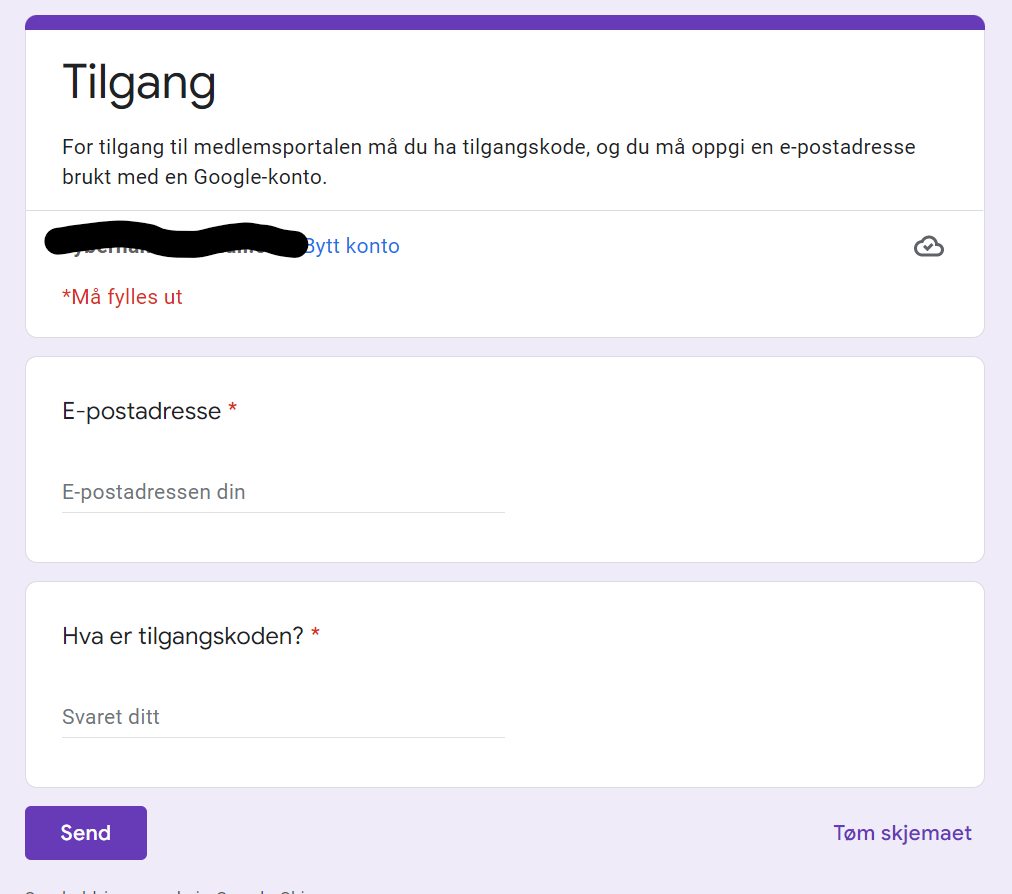
Let’s assume our users have received an access code that grants them access to the site, for example in a purchase process. We can create a Google Form for people to get access after obtaining this code. They will have to add their Gmail address + the secret access code.
Signup form for our membership page (also in Norwegian, tilgangskode = access code)
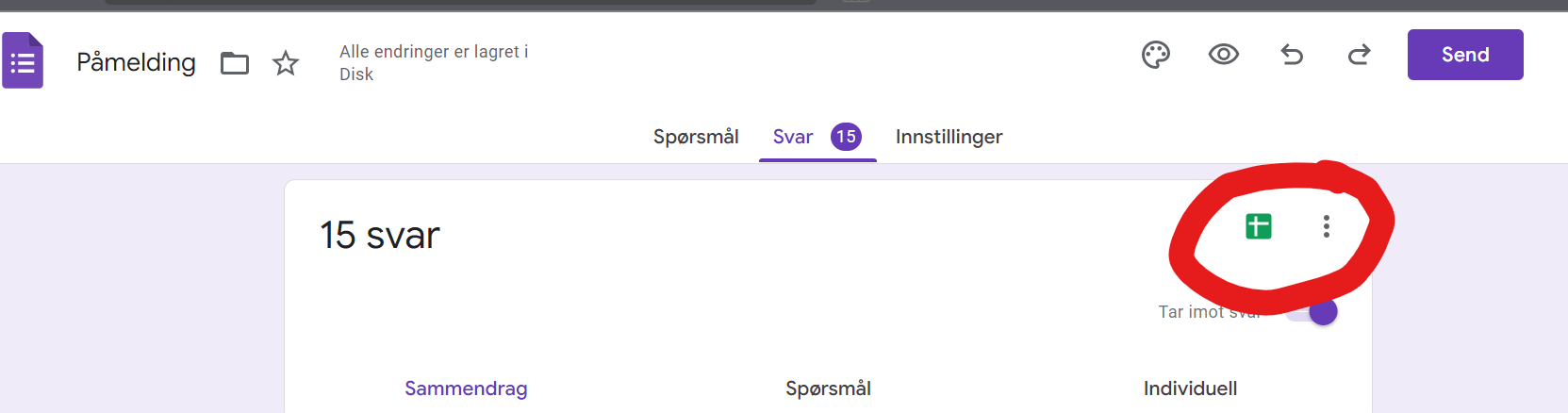
When the user submits this form, we need to process it and grant access to the parent folder of our membership site. First, make sure you go into the answers section, and click the “Google Sheet” symbol to create a Sheet for containing the signups.
Click the green Sheet symbol to create a Google Sheet to hold signup answers.
In Sheets, we create two extra tabs – one for the “secret access code”, and another for a block list in case there are users we want to deny signing up. To make the data from the spreadsheet accessible to Google App Script, we now click the Google App Script link on the Extensions menu in the Google Sheet.
Go to App Script!
Don’t miss future secure and tech posts – sign up here to be notified!
In App Script, we add the Sheets + Gmail services. We create a function to be triggered each time the form is submitted. Our function is called onFormSubmit. We click the “trigger button” in the editor to add a trigger to make this happen.
Trigger button looks like a clock!
In the trigger config, choose trigger source to be “spreadsheet”, and event type to “form submission”. Now the trigger is done, and it is time to write some code. In pseudocode form, this is what needs to happen:
Get the e-mail address of the new user + the access code submitted by the user
Check if the access code is correct
If correct, check if the user is on a block list. If the user is not blocked, grant access to the parent folder of the membership site using the Google Drive service. Send an e-mail to the user that access has been granted.
If incorrect, don’t grant access. Perhaps log the event
The App Script code is just JavaScript. Here’s our implementation.
function onFormSubmit(event) {
var useremail = event.values[1]
var accesscode = event.values[2]
var correctcode = sheetTest()
var blocked = getBlockedUsers()
console.log(blocked)
if (accesscode == correctcode) {
if (blocked.flat().includes(useremail)) {
Logger.log("Blocked user is attempting access: " + useremail)
} else {
Logger.log("Provide user with access: " + useremail)
var secretfolder = DriveApp.getFolderById("<id-of-folder>")
secretfolder.addViewer(useremail)
GmailApp.sendEmail(useremail, "Access to Membership Site", "Body text for email goes here...")
}
} else {
Logger.log("Deny user access")
}
}
function sheetTest() {
var sheet = SpreadsheetApp.openById("<Spreadsheet-ID>");
var thiscell = sheet.getSheets()[1].getDataRange().getValues()
var correctcode = thiscell[thiscell.length-1][0];
return correctcode
}
function getBlockedUsers() {
var sheet = SpreadsheetApp.openById("<Spreadsheet-ID>");
var blocklist = sheet.getSheets()[2].getDataRange().getValues()
return blocklist
}
Now, we are done with the “backend”. We can now create links in the navigation menus between the public site and the membership one, and you will have a functioning Google Site with a membership area as seen from the user’s point of view.
Modern operating systems have robust systems for creating audit trails built-in. They are very useful for detecting attacks, and understanding what has happened on a machine.
To make sense of the crime you need evidence. Ensure you capture enough logs to handle relevant threat scenarios against your assets.
Not all the features that are useful for security monitoring are turned on by default – you need to plan auditing. The more you audit, the more visibility you gain in theory, but there are trade-offs.
More data gives you more data – and more noise. Logging more than you need makes it harder to find the events that matter
More data can be useful for visibility, but can also quickly fill up your disk with logs if you turn on too much
More data can give you increased visibility of what is going on, but this can be at odds with privacy requirements and expectations
Brute-force attacks: export data and use Excel to make sense of it
Brute-force attacks are popular among attackers, because there are many systems using weak passwords and that are lacking reasonable password policies. You can easily defend against naive brute-force attacks using rate limiting and account lockouts.
If you expose your computer directly on the Internet on port 3389 (RDP), you will quickly see thousands of login attempts. The obvious answer to this problem is to avoid exposing RDP directly on the Internet. This will also cut away a lot of the noise, making it easier to detect actual intrusions.
Logon attempts on Windows will generate Event ID 4625 for failed logons, and Event ID 4624 for successful logons. An easy way to detect naive attacks is thus to look for a series of failed attempts in a short time for the same username, followed by a successful logon for the same user. A practical way to do this, is to use PowerShell to extract the relevant data, and export it to a csv file. You can then import the data to Excel for easy analysis.
For a system exposed on the Internet, there will be thousands of logons for various users. Exporting data for non-existent users makes no sense (this is noise), so it can be a good idea to pull out the users first. If we are interested in detecting attacks on local users on a machine, we can use the following Cmdlet:
Now we first fetch the logs with Event ID’s 4624, 4625. You need to do this from an elevated shell to read the events from the Windows security log. For more details on scripting log analysis and making sense of the XML log format that Windows is using, please refer to this excellent blog post: How to track Windows events with Powershell.
Now we can loop over the $events variable and pull out the relevant data. Note that we check that the logon attempt is for a target account that is a valid user account on our system.
Now we can import the data in Excel to analyze it. We have detected there are many logon attempts for the username “victim”, and filtering on this value clearly shows what has happened.
TimeCreated
EventID
TargetUserName
LogonType
WorkstationName
IpAddress
3/6/2022 9:26:54 PM
4624
victim
Network
WinDev2202Eval
REDACTED
3/6/2022 9:26:54 PM
4625
victim
Network
WinDev2202Eval
REDACTED
3/6/2022 9:26:54 PM
4625
victim
Network
WinDev2202Eval
REDACTED
3/6/2022 9:26:54 PM
4625
victim
Network
WinDev2202Eval
REDACTED
3/6/2022 9:26:54 PM
4625
victim
Network
WinDev2202Eval
REDACTED
3/6/2022 9:26:54 PM
4625
victim
Network
WinDev2202Eval
REDACTED
3/6/2022 9:26:54 PM
4625
victim
Network
WinDev2202Eval
REDACTED
3/6/2022 9:26:53 PM
4625
victim
Network
WinDev2202Eval
REDACTED
3/6/2022 9:26:53 PM
4625
victim
Network
WinDev2202Eval
REDACTED
3/6/2022 9:26:53 PM
4625
victim
Network
WinDev2202Eval
REDACTED
3/6/2022 9:26:53 PM
4625
victim
Network
WinDev2202Eval
REDACTED
3/6/2022 9:23:38 PM
4625
victim
Network
WinDev2202Eval
REDACTED
3/6/2022 9:23:37 PM
4625
victim
Network
WinDev2202Eval
REDACTED
3/6/2022 9:23:37 PM
4624
victim
Network
WinDev2202Eval
REDACTED
3/6/2022 9:23:37 PM
4625
victim
Network
WinDev2202Eval
REDACTED
3/6/2022 9:23:37 PM
4625
victim
Network
WinDev2202Eval
REDACTED
3/6/2022 9:23:37 PM
4625
victim
Network
WinDev2202Eval
REDACTED
3/6/2022 9:23:37 PM
4625
victim
Network
WinDev2202Eval
REDACTED
3/6/2022 9:23:37 PM
4625
victim
Network
WinDev2202Eval
REDACTED
3/6/2022 9:23:37 PM
4625
victim
Network
WinDev2202Eval
REDACTED
3/6/2022 9:23:37 PM
4625
victim
Network
WinDev2202Eval
REDACTED
3/6/2022 9:23:37 PM
4625
victim
Network
WinDev2202Eval
REDACTED
3/6/2022 9:23:37 PM
4625
victim
Network
WinDev2202Eval
REDACTED
3/6/2022 9:23:37 PM
4625
victim
Network
WinDev2202Eval
REDACTED
Log showing successful brute-force attack coming from a Windows workstation called WinDev2202Eval, with the source ip address.
Engineering visibility
The above is a simple example of how scripting can help pull out local logs. This works well for an investigation after an intrusion but you want to detect attack patterns before that. That is why you want to forward logs to a SIEM, and to create alerts based on attack patterns.
For logon events the relevant logs are created by Windows without changing audit policies. There are many other very useful security logs that can be generated on Windows, that require you to activate them. Two very useful events are the following:
Event ID 4688: A process was created. This can be used to capture what an attacker is doing as post-exploitation.
Event ID 4698: A scheduled task was created. This is good for detecting a common tactic for persistence.
Taking into account the trade-offs mentioned in the beginning of this post, turning on the necessary auditing should be part of your security strategy.
Securing operational technologies (OT) is different from securing enterprise IT systems. Not because the technologies themselves are so different – but the consequences are. OT systems are used to control all sorts of systems we rely on for modern society to function; oil tankers, high-speed trains, nuclear power plants. What is the worst thing that could happen, if hackers take control of the information and communication technology based systems used to operate and safeguard such systems? Obviously, the consequences could be significantly worse than a data leak showing who the customers of an adult dating site are. Death is generally worse than embarrassment.
No electricity could be a consequence of an OT attack.
When people think about cybersecurity, they typically think about confidentiality. IT security professionals will take a more complete view of data security by considering not only confidentiality, but also integrity and availability. For most enterprise IT systems, the consequences of hacking are financial, and sometimes also legal. Think about data breaches involving personal data – we regularly see stories about companies and also government agencies being fined for lack of privacy protections. This kind of thinking is often brought into industrial domains; people doing risk assessments describe consequences in terms such as “unauthorized access to data” or “data could be changed be an unauthorized individual”.
The real consequences we worry about are physical. Can a targeted attack cause a major accident at an industrial plant, leaking poisonous chemicals into the surroundings or starting a huge fire? Can damage to manufacturing equipment disrupt important supply-chains, thereby causing shortages of critical goods such as fuels or food? That is the kind of consequences we should worry about, and these are the scenarios we need to use when prioritizing risks.
Let’s look at three steps we can take to make cyber risks in the physical world more tangible.
Step 1 – connect the dots in your inventory
Two important tools for cyber defenders of all types are “network topologies” and “asset inventory”. If you do not have that type of visibility in place, you can’t defend your systems. You need to know what you have to defend it. A network topology is typically a drawing showing you what your network consists of, like network segments, servers, laptops, switches, and also OT equipment like PLC’s (programmable logic curcuits), pressure transmitters and HMI’s (human-machine interfaces – typically the software used to interact with the sensors and controllers in an industrial plant). Here’s a simple example:
An example of a simplified network topology
A drawing like this would be instantly recognizable to anyone working with IT or OT systems. In addition to this, you would typically want to have an inventory describing all your hardware systems, as well as all the software running on your hardware. In an environment where things change often, this should be generated dynamically. Often, in OT systems, these will exist as static files such as Excel files, manually compiled by engineers during system design. It is highly likely to be out of date after some time due to lack of updates when changes happen.
Performing a risk assessment based on these two common descriptions is a common exercise. The problem is, that it is very hard to connect this information to the physical consequences we want to safeguard against. We need to know what the “equipment under control” is, and what it is used for. For example, the above network may be used to operate a batch chemical reactor running an exothermic reaction. That is, a reaction that produces heat. Such reactions need cooling, if not the system could overheat, and potentially explode as well if it produces gaseous products. We can’t see that information from the IT-type documentation alone; we need to connect this information to the physical world.
Let’s say the system above is controlling a reactor that has a heat-producing reaction. This reactor needs cooling, which is provided by supplying cooling water to a jacket outside the actual reactor vessel. A controller opens and closes a valve based on a temperature measurement in order to maintain a safe temperature. This controller is the “Temperature Control PLC” in the drawing above. Knowing this, makes the physical risk visible.
Without knowing what our OT system controls, we would be led to think about the CIA triad, not really considering that the real consequences could be a severe explosion that could kill nearby workers, destroy assets, release dangerous chemical to the environment, and even cause damage to neighboring properties. Unfortunately, lack of inventory control, especially connecting industrial IT systems to the physical assets they control, is a very common problem (disclaimer – this is an article from DNV, where I am employed) across many industries.
An example of a physical system: a continuously stirred-tank reactor (CSTR) for producing a chemical in a batch-type process.
Step 1 – connect the dots: For every server, switch, transmitter, PLC and so on in your network, you need to know what jobs these items are a part of performing. Only that way, you can understand the potential consequences of a cyberattack against the OT system.
Step 2 – make friends with physical domain experts
If you work in OT security, you need to master a lot of complexity. You are perhaps an expert in industrial protocols, ladder logic programming, or building adversarial threat models? Understanding the security domain is itself a challenge, and expecting security experts to also be experts in all the physical domains they touch, is unrealistic. You can’t expect OT security experts to know the details of all the technologies described as “equipment under control” in ISO standards. Should your SOC analyst be a trained chemical engineer as well as an OT security expert? Or should she know the details of steel strength decreases with a temperature increase due to being engulfed in a jet fire? Of course not – nobody can be an expert at everything.
This is why risk assessments have to be collaborative; you need to make sure you get the input from relevant disciplines when considering risk scenarios. Going back to the chemical reactor discussed above, a social engineering incident scenario could be as follows.
John, who works as a plant engineer, receives a phishing e-mail that he falls for. Believing the attachment to be a legitimate instruction of re-calibration of the temperature sensor used in the reactor cooling control system, he executes the recipe from the the attachment in the e-mail. This tells him to download a Python file from Dropbox folder, and execute it on the SCADA server. By doing so, he calibrates the temperature sensor to report 10 degrees lower temperature than what it really measures. It also installs a backdoor on the SCADA server, allowing hackers to take full control of it over the Internet.
The consequences of this could potentially overpressurizing the reactor, causing a deadly explosion. The lack of cooling on the reactor would make a chemical engineering react, and help understand the potential physical consequences. Make friends with domain experts.
Another important aspect of domain expertise, is knowing the safety barriers. The example above was lacking several safety features that would be mandatory in most locations, such as having a passive pressure-relief system that works without the involvement of any digital technologies. In many locations it is also mandatory to have a process shutdown systems, a control system with separate sensors, PLC’s and networks to intervene and stop the potential accident from happening by using actuators also put in place only for safety use, in order to avoid common cause failures between normal production systems and safety critical systems. Lack of awareness of such systems can sometimes make OT security experts exaggerate the probability of the most severe consequences.
Step 2 – Make friends with domain experts. By involving the right domain expertise, you can get a realistic picture of the physical consequences of a scenario.
Step 3 – Respond in context
If you find yourself having to defend industrial systems against attacks, you need an incident response plan. This is no different from an enterprise IT environment; you also need an incident response plan that takes the operational context into account here. A key difference, though, is that for physical plants your response plan may actually involve taking physical action, such as manually opening and closing valves. Obviously, this needs to be planned – and exercised.
If welding will be a necessary part of handling your incident, coordinating with the industrial operations side better be part of your incident response playbooks.
Even attacks that do not affect OT systems directly, may lead to operational changes in the industrial environment. Hydro, for example, was hit with a ransomware attack in 2019, crippling its enterprise IT systems. This forced the company to turn to manual operations of its aluminum production plants. This bears lessons for us all, we need to think about how to minimize impact not just after an attack, but also during the response phase, which may be quite extensive.
Scenario-based playbooks can be of great help in planning as well as execution of response. When creating the playbook we should
describe the scenario in sufficient detail to estimate affected systems
ask what it will take to return to operations if affected systems will have to be taken out of service
The latter question would be very difficult to answer for an OT security expert. Again, you need your domain expertise. In terms of the cyber incident response plan, this would lead to information on who to contact during response, who has the authority to make decision about when to move to next steps, and so on. For example, if you need to switch to manual operations in order to continue with recovery of control system ICT equipment in a safe way, this has to be part of your playbook.
Step 3 – Plan and exercise incident response playbooks together with industrial operations. If valves need to be turned, or new pipe bypasses welded on as part of your response activities, this should be part of your playbook.
OT security is about saving lives, the environment and avoiding asset damage
In the discussion above it was not much mention of the CIA triad (confidentiality, integrity and availability), although seen from the OT system point of view, that is still the level we operate at. We still need to ensure only authorized personnel has access to our systems, we need to ensure we protect data during transit and in storage, and we need to know that a packet storm isn’t going to take our industrial network down. The point we want to make is that we need to better articulate the consequences of security breaches in the OT system.
Step 1 – know what you have. It is often not enough to know what IT components you have in your system. You need to know what they are controlling too. This is important for understanding the risk related to a compromise of the asset, but also for planning how to respond to an attack.
Step 2 – make friends with domain experts. They can help you understand if a compromised asset could lead to a catastrophic scenario, and what it would take for an attacker to make that happen. Domain experts can also help you understand independent safety barriers that are part of the design, so you don’t exaggerate the probability of the worst-case scenarios.
Step 3 – plan your response with the industrial context in mind. Use the insight of domain experts (that you know are friends with) to make practical playbooks – that may include physical actions that need to be taken on the factory floor by welders or process operators.
To build organizations with cultures that reinforce security, we need to turn from awareness training, to a holistic approach taking human performance into account. In this post, we look at performance shaping factors as part of the root cause of poor security decisions, and suggest 4 key delivery domains for improved cybersecurity performance in organizations; leadership, integrating security in work processes, getting help when needed, and finally, delivering training and content.
This is a blog post about what most people call “security awareness”. This term is terrible; being aware that security exists doesn’t really help much. I’ve called it “pointing fingers solves nothing” – because a lot of what we do to build security awareness, has little to no effect. Or sometimes, the activities we introduce can even make us more likely to get hacked!
We want organizational cultures that make us less vulnerable to cyber threats. Phishing your own employees and forcing them to click through e-learning modules about hovering links in e-mails will not give us that.
What do we actually want to achieve?
Cybersecurity has to support the business in reaching its goals. All companies have a purpose; there is a reason they exist. Why should people working at a cinema care about cybersecurity for example? Let us start with a hypothetical statement of why you started a cinema!
What does the desire to share the love of films have to do with cybersecurity? Everything!
We love film. We want everyone to be able to come here and experience the magic of the big screen, the smell of popcorn and feeling as this is the only world that exists.
Mr. Moon (Movie Theater Entrepreneur)
Running a cinema will expose you to a lot of business risks. Because of all the connected technologies we use to run our businesses, a cyber attack can disturb almost any business, including a cinema. It could stop ticket sales, and the ability to check tickets. It could cost so much money that the cinema goes bankrupt, for example through ransomware. It could lead to liability issues if a personal data breach occurs, and the data was not protected as required by law. In other words; there are many reasons for cinema entrepreneurs to care about cybersecurity!
An “awareness program” should make the cinema more resilient to cyber attacks. We want to reach a state where the following would be true:
We know how to integrate security into our work
We know how information security helps us deliver on our true purpose
We know how to get help with security when we need it
Knowing when and how to get help is a key cybersecurity capability
Design principles for awareness programs
We have concluded that we want security be a natural part of how we work, and that people are motivated to follow the expected practices. We also know from research that the reason people click on a phishing e-mail or postpones updating their smartphone, is not a lack of knowledge, but rather a lack of motivation to prioritize security over short-term productivity. There can be many reasons for this, ranging from lack of situational awareness to stress and lack of time.
From human factors engineering, we know that our performance at work depends on many factors. There are factors that can significantly degrade our capability to make the right decisions, despite having the knowledge required to make the right decisions. According to the SPAR-H methodology for human reliability analysis, the following PSF’s (performance shaping factors) can greatly influence our ability to make good decisions:
Available time
Stress/stressors
Task complexity
Experience and training
Procedures
Human-machine interface
Fitness for duty
It is thus clear that telling people to avoid clicking suspicious links in e-mails from strangers will not be enough to improve the cybersecurity performance of the organization. When we want our program to actually make our organization less likely to see severe consequences from cyber attacks we need to do more. To guide us in making such a program, I suggest the following 7 design principles for building security cultures:
Management must show that security is a priority
Motivation before knowledge
Policies are available and understandable
Culture optimizing for human reliability
Do’s before don’ts
Trust your own paranoia – report suspicious observations
Talk the walk – keep security on the agenda
Based on these principles, we collect activities into four delivery domains for cybersecurity awareness;
Leadership
Work integration
Access to help
Training and content
The traditional “awareness” practices we all know such as threat briefs, e-learning and simulated phishing campaigns fit into the fourth domain here. Those activities can help us build cyber resilience but they do depend on the three other domains supporting the training content.
Delivery domain 1 – Leadership
Leaders play a very important role in the implementation of a security aware organization culture. The most important part of the responsibility of leaders is to motivate people to follow security practices. When leaders respect security policies, and make this visible, it inspires and nudges others to follow those practices too. Leaders should also share how security helps support the purpose of the organization. Sharing the vision is perhaps the most important internally facing job of senior management, and connecting security to that vision is an important part of the job. Without security, the vision is much more likely to never materialize, it will remain a dream.
Further, leaders should seek to draw in relevant security stories to drive motivation for good practice. When a competitor is hit with ransomware, the leader should draw focus to it internally. When the organization was subject to a targeted attack, but the attack never managed to cause any harm due to good security controls, that is also worth sharing; the security work we do every day is what allows us to keep delivering services and products to customers.
The leadership wheel; building motivation for security is a continuous process
Delivery domain 2 – work integration
Integrating security practices into how we deliver work, is perhaps the most important deliberate action to take for organizations. The key tool we need to make this reality is threat modeling. We draw up the business process in a flowchart, and then start to think like an attacker. How could cyber attacks disturb or exploit our business process? Then we build the necessary controls into the process. Finally, we need to monitor if the security controls are working as intended, and improve where we see gaps. This way, security moves from something we focus on whenever we read about ransomware in the news, to something we do every day as part of our normal jobs.
Let’s take an example. At our cinema, a key business process is selling tickets to our movies. We operate in an old-fashioned way, and the only way to buy tickets is to go to the ticket booth at the entrance of the cinema and buy your ticket.
How can cyber attacks disturb ticket sales over the counter?
Let’s outline what is needed to buy a ticket:
A computer connected a database showing available tickets
Network to send confirmation of ticket purchase to the buyer
Printer to print paper tickets
A payment solution to accept credit card payments, and perhaps also cash
There are many cyber attacks that could create problems here. A ransomware attack removing the ability to operate the ticket inventory for example, or a DDoS attack stopping the system from sending ticket ocnfirmations. Also, if the computer used by the seller is also used for other things such as e-mail and internet browsing, there are even more possibilities of attacks. We can integrate some security controls into this process:
Use only a hardened computer for the ticket sales
Set up ticket inventory systems that are less vulnerable to common attacks, e.g. use a software-as-a-service solution with good security. Choosing software tools with good security posture is always a good idea.
Provide training to the sales personnel on common threats that could affect ticket sales, including phishing, no shadow IT usage, and how to report potential security incidents
By going through every business process like this, and looking at how we can improve the cybersecurity for each process, we help make security a part of the process, a part of how we do business. And as we know, consistency beats bursts of effort, every time.
Consistency beats motivational bursts every time. Make security a part of how we do work every day, and focus on continuous improvement. That’s how we beat the bad guys, again and again.
Delivery domain 3 – access to help
Delivery domain 3 is about access to help. You don’t build security alone, we do it together. There are two different types of help you need to make available:
I need help to prepare so that our workflows and our knowledge is good enough. Software developers may need help from security specialists to develop threat models or improve architectures. IT departments may need help designing and setting up security tools to detect and stop attacks. These are things we do before we are attacked, and that will help us reduce the probability of a successful attack, and help us manage attacks when they happen.
The other type of help we need, is when we have an active attack. We need to know who to call to get help kicking the cyber adversaries out and reestablishing our business capabilities
You may have the necessary competence in your organization to both build solid security architectures (help type 1) and to respond to incidents (help type 2). If not, you may want to hire consultants to help you design the required security controls. You may also want to contract with a service provider that offers managed detection and response, where the service provider will take care of monitoring your systems and responding to attacks. You could also sign up for an incident response retainer; then you have an on-call team you can call when the cyber villains are inside your systems and causing harm.
Delivery domain 4 – training and content
Our final domain is where the content lives. This is where you provide e-learning, you do phishing simulations, and write blog posts.
About 50% of the effort done in providing the “knowledge part” of awareness training should be focused on baseline security. These are security aspects that everyone in the organization would need to know. Some typical examples of useful topics include the following:
Social engineering and phishing: typical social engineering attacks and how to avoid getting tricked
Policies and requirements: what are the rules and requirements we need to follow?
Reporting and getting help: how do we report a security incident, and what happens then?
Threats and key controls: why do we have the controls we do and how do they help us stop attacks?
Shadow IT: why we should only use approved tools and systems
Simulated phishing attacks are commonly used as part of training. The effect of this is questionable if done the way most organizations do them; send out a collection of phishing e-mails and track who is clicking them, or providing credentials on a fake login page. Everyone can be tricked if the attack is credible enough, and this can quickly turn into a blame game eroding trust in the organization.
Simulated phishing can be effective to provide more practical insights into how social engineering works. In other words, if it is used as part of training, and not primarily as a measurement, it can be good. It is important to avoid “pointing fingers”, and remember that our ability to make good decisions are shaped less by knowledge than performance shaping factors. If you see that too many people are falling for phishing campaigns, consider what could be the cause of this.
When it comes to e-learning, this can be a good way to provide content to a large population, and manage the fact that people join and leave organizations all the time. E-learning content should be easy to consume, and in small enough chunks to avoid becoming a drain on people’s time.
In addition to the baseline training we have discussed here, people who are likely to be targeted with specific attacks, or whose jobs increase the chance of severe consequences of cyber attacks, should get specific training relevant to their roles. For example, a financial department’s workers with authority to pay invoices, should get training in avoiding getting tricked by fake invoices, or to fall for typical fraud types related to business payments.
The last part should close the circle by helping management provide motivation for security. Are there recent incidents managers should know about? Managers should also get security metrics that provide insight into the performance of the organization, both for communication to the people in the organization, and to know if they resources they are investing in for security are actually bringing the desired benefit.
tl;dr – key takeaways for security awareness pushers
The most important take-away from this post is the fact that people’s performance when making security decisions is shaped both by knowledge, and by performance shaping factors. Building a strong security culture should optimize for good security decisions. This means we need to take both knowledge, leadership and the working environment into account. We have suggested 7 design principles to help build awareness programs that work. The principles are:
Management must show that security is a priority
Motivation before knowledge
Policies are available and understandable
Culture optimizing for human reliability
Do’s before don’ts
Trust your own paranoia – report suspicious observations
Talk the walk – keep security on the agenda
Based on the principles we suggested that awareness programs consider 4 delivery domains: Leadership, Work Integration, Access to Help, and Training & Content.