
CCSK Domain 1: Cloud Computing Concepts and Architecture

Recently I participated in a one-day class on the contents required for the “Certificate of Cloud Security Knowledge” held by Peter HJ van Eijk in Trondheim as part of the conference Sikkerhet og Sårbarhet 2019 (translates from Norwegian to: Security and Vulnerability 2019). The one-day workshop was interesting and the instructor was good at creating interactive discussions – making it much better than the typical PowerPoint overdose of commmercial professional training sessions. There is a certification exam that I have not yet taken, and I decided I should document my notes on my blog; perhaps others can find some use for them too.

The CCSK exam closely follows a document made by the Cloud Security Alliance (CSA) called “CSA Security Guidance for Critical Areas of Focus in Cloud Computing v4.0” – a document you can download for free from the CSA webpage. They also lean on ENISA’s “Cloud Computing Risk Assessment”, which is also a free download.

Cloud computing isn’t about who owns the compute resources (someone else’s computer) – it is about providing scale and cost benefits through rapid elasticity, self-service, shared resource pools and a shared security responsibility model.

The way I’ll do these blog posts is that I’ll first share my notes, and then give a quick comment on what the whole thing means from my point of view (which may not really be that relevant to the CCSK exam if you came here for a shortcut to that).

Introduction to D1 (Cloud Concepts and Architecture)

Domain 1 contains 4 sections:  

  • Defining cloud computing 
  • The cloud logical model 
  • Cloud conceptual, architectural and reference model 
  • Cloud security and compliance scope, responsibilities and models 

NIST definition of cloud computing: a model for ensuring ubiquitous, convenient, on-demand network access to a shared pool for configurable computing resources that can be rapidly provisioned and released with minimal management effort or service provider interaction. 

A Cloud User is the person or organization requesting computational resources. The Cloud Provider is the person or organization offering the resources. 

Key techniques to create a cloud:  

  • Abstraction: we abstract resources from the underlying infrastructure to create resource pools  
  • Orchestration: coordination of delivering resources out of the pool on demand.  

Clouds are multitenant by nature. Consumers are segregated and isolated but share resource pools.  

Cloud computing models 

The foundation model of cloud computing of the CSA is the NIST model. A more in-depth model used as a reference model is taken from ISO/IEC.  The guidance talks mostly about the NIST model and doesn’t dive into the ISO/IEC model, which probably is sufficient for most definition needs.

Cloud computing has 5 charcteristics:

  1. Shared resource pool (compute resources in a pool that consumers can pull from)
  2. Rapid elasticity (can scale up and down quickly)
  3. Broad network access
  4. On-demand self-service (management plane, API’s)
  5. Measured service (pay-as-you-go)

Cloud computing has 3 service models

  • Software as a Service (SaaS): like Cybehave or Salesforce
  • Platform as a Service (PaaS): like WordPress or AWS Elastic Beanstalk
  • Infrastructure as a Service (IaaS): like VM’s running in Google Cloud

Cloud computing has 4 deployment models:

  • Public Cloud: pool shared by anyone
  • Private Cloud: pool shared within an organization
  • Hybrid Cloud: connection between two clouds, commonly used when an on-prem datacenter connects to a public cloud
  • Community Cloud: pool shared by a community, for example insurance companies that have formed some form of consortium

Models for discussing cloud security

The CSA document discusses multiple model type in a somewhat incoherent manner. The types of models it mentions can be categorized as follows:

  • Conceptual models: descriptions to explain concepts, such as the logic model from CSA.  
  • Controls models: like CCM 
  • Reference architectures: templates for implementing security controls 
  • Design patterns: solutions to particular problems 

The document also outlines a simple cloud security process model 

  • Identify security and compliance requirements, and existing controls 
  • Select provider, service and deployment models 
  • Define the architecture 
  • Assess the security controls 
  • Identify control gaps 
  • Design and implement controls to fill gaps 
  • Manage changes over time 

The CSA logic model

This model explains 4 “layers” of a cloud enviornment and introduces some “funny words”:

  • Infrastructure: the core components in computing infrastructure, such as servers, storage and networks 
  • Metastructure: protocols and mechanisms providing connections between infrastructure and the other layers 
  • Infostructure: The data and information (database records, file storage, etc) 
  • Applistructure: The applications deployed in the cloud and the underlying applications used ot build them. 

The key difference between traditional IT and cloud is the metastructure. Cloud metastructure contains the management plane components.  

Another key feature of cloud is that each layer tends to double. For example infrastructure is managed by the cloud provider, but the cloud consumer will establish a virtual infrastructure that will also need ot be managed (at least in the case of IaaS). 

Cloud security scope and responsibilities 

The responsibility for security domains maps to the access the different stakeholders have to each layer in the architecture stack.  

  • SaaS: cloud provider is responsible for perimeter, logging, and application security and the consumer may only have access to provision users and manage entitlemnets 
  • PaaS: the provider is typically responsible for platform security and the consumer is responsible for the security of the solutions deployed on the platform. Configuring the offered security features is often left to the consumer.  
  • IaaS: cloud provider is responsible for hypervisors, host OS, hardware and facilities, consumer for guest OS and up in the stack.  

Shared responsibility model leaves us with two focus areas:  

  • Cloud providers should clearly document internal security management and security controls available to consumers.  
  • Consumers should create a responsibility matrix to make sure controls are followed up by one of the parties 

Two compliance tools exist from the CSA and are recommended for mapping security controls:  

  • The Consensus Assessment Initiative Questionnaire (CAIQ) 
  • The Cloud Controls Matrix (CCM) 

#2cents

This domain is introductory and provides some terminology for discussing cloud computing. The key aspects from a risk management point of view are:

  • Cloud creates new risks that need to be managed, especially as it introduces more companies involved in maintaining security of the full stack compared to a full in-house managed stack. Requirements, contracts and audits become important tools.
  • The NIST model is more or less universally used in cloud discussions in practice. The service models are known to most IT practitioners, at least on the operations side.
  • The CSA guidance correctly designates the “metastructure” as the new kid on the block. The practical incarnation of this is API’s and console access (e.g. gcloud at API level and Google Cloud Console on “management plane” level). From a security point of view this means that maintaining security of local control libraries becomes very important, as well as identity and access management for the control plane in general.

In addition to the “who does what” problem that can occur with a shared security model, the self-service and fast-scaling properties of cloud computing often lead to “new and shiny” being pushed faster than security is aware of. An often overlooked part of “pushing security left” is that we also need to push both knowledge and accountability together with the ability to access the management plane (or parts of it through API’s or the cloud management console).

How to reduce cybersecurity risks for stores, shops and small businesses

Crime in general is moving online, and with that the digital risks for all businesses are increasing, including for traditional physical stores – as well as eCommerce sites. This blog post is a quick summary of some risks that are growing quickly and what shop owners can do to better control them.

Top 10 Cybersecurity Risks

The following risks are faced by most organizations. For many stores selling physical goods these would be devastating today as they rely more and more on digital services.

How secure is your shop when you include the digital arena? Do you put your customers at risk?
  1. Point of sale malware leading to stolen credit cards
  2. Supply chain disruptions due to cybersecurity incidents
  3. Ransomware on computers used to manage and run stores
  4. Physical system manipulation through sensors and IoT, e.g. an adversary turning off the cooling in a grocery store’s refrigerators
  5. Website hacks
  6. Hacking of customer’s mobile devices due to insecure wireless network
  7. Intrusion into systems via insecure networks
  8. Unavailability of critical digital services due to cyber incidents (e.g. SaaS systems needed to operate the business)
  9. Lack of IT competence to help respond to incidents
  10. Compromised e-mail accounts and social media accounts used to run the business

Securing the shop

Shop owners have long been used to securing their stores against physical theft – using alarms, guards and locks. Here are 5 things all shop owners can do to also secure their businesses against cybersecurity events:

1 – Use only up-to-date IT equipment and software.

Outdated software can be exploited by malware. Keeping software up to date drastically reduces the risk of infection. If you have equipment that cannot be upgraded because it is too old you should get rid of it. The rest should receive updates as quickly as possible when they are made avialable, preferably automatically if possible.

2 – Create a security awareness program for employees.

No business is stronger than its weakest link – and that is true for security too. By teaching employees good cybersecurity habits the risk of an employee downloading a dangerous attachment or accepting a shady excuse for weird behavior from a criminal will be much lower. A combination of on-site discussions and e-learning that can be consumed on mobile devices can be effective for delivering this.

3 – Use the guest network only for guests.

Many stores, coffee shops and other businesses offer free wifi for their customers. Make sure you avoid connecting critical equipment to this network as vulnerabilities can be exposed. Things I’ve seen on networks like this include thermostats, cash registers and printers. Use a separate network for those important things, and do not let outsiders onto that network.

4 – Secure your website like your front door.

Businesses will usually have a web site, quite often with some form of sales and marketing integration – but even if you don’t have anything else than a pretty static web page you should take care of its security. If it is down you lose a few customers, if it is hacked and customers are tricked out of their credit card data they will blame your shop, not the firm you bought the web design from. Make sure you require web designers to maintain and keep your site up to date, and that they follow best practices for web security. You should also consider running a security test of the web page on regular intervals.

5 – Prepare for times of trouble.

You should prepare for bad things to happen and have a plan in place for dealing with it. The basis for creating an incident response plan is a risk assessment that lists the potential threat scenarios. This will also help you come up with security measures that will make those scenarios less likely to occur.

6 – Create backups and test them!

The best medicine against losing data is having a recent backup and knowing how to restore your system. Make sure all critical data are backed up regularly. If you are using a cloud software for critical functions such as customer relationship management (CRM) or accounting, check with your vendor what backup options they have. Ideally your backups should be stored in a location that is not depending on the same infrastructure as the software itself. For example – if Google runs your software you can store your backups with Microsoft.

7 – Minimize the danger of hacked accounts.

The most common way a company gets hacked is a compromised account. This very often happens because of phishing or password reuse. Phishing is the use of e-mails to trick users into giving up their passwords – for example by sending them to a fake login page that is controlled by the hacker. Three things you can do that will reduce this risk by 99% is:

  • Tell everyone to use a password manager and ask them to use very long and complex passwords. They will no longer need to remember the passwords themselves so this will not be a problem. Examples of such software include 1Password and Lastpass.
  • Enforce two-factor authentication wherever possible (2FA for short). 2FA is the use of a second factor in addition to your password, such as a code generated on you mobile in order to log in.
  • Give everyone training on detection of social engineering scams as part of your awareness training program.

All of this may seem like quite a lot of work – but when it becomes a habit it will make your team more efficient, and will significantly reduce the cybersecurity threats for both you and your customers.

If you need tools for awareness training, risk management or just someone to talk to about security – take a look at the offerings from Cybehave – intelligent cloud software for better security.

Running an automated security audit using Burp Professional

Reading about hacking in the news can make it seem like anyone can just point a tool at any website and completely take it over. This is not really the case, as hacking, whether automated or manual, requires vulnerabilities.

A well-known tool for security professionals working with web applications is Burp from Portswigger. This is an excellent tool, and comes in multiple editions from the free community edition, which is a nice proxy that you can use to study HTTP requests and responses (and some other things), to the professional edition aimed at pentesting and enterprise which is more for DevOps automation. In this little test we’ll take the Burp Professional tool and run it using only default settings against a target application I made last year. This app is a simple app for posting things on the internet, and was just a small project I did to learn how to use some of the AWS tools for deployment and monitoring. You find it in all its glory at https://www.woodscreaming.com.

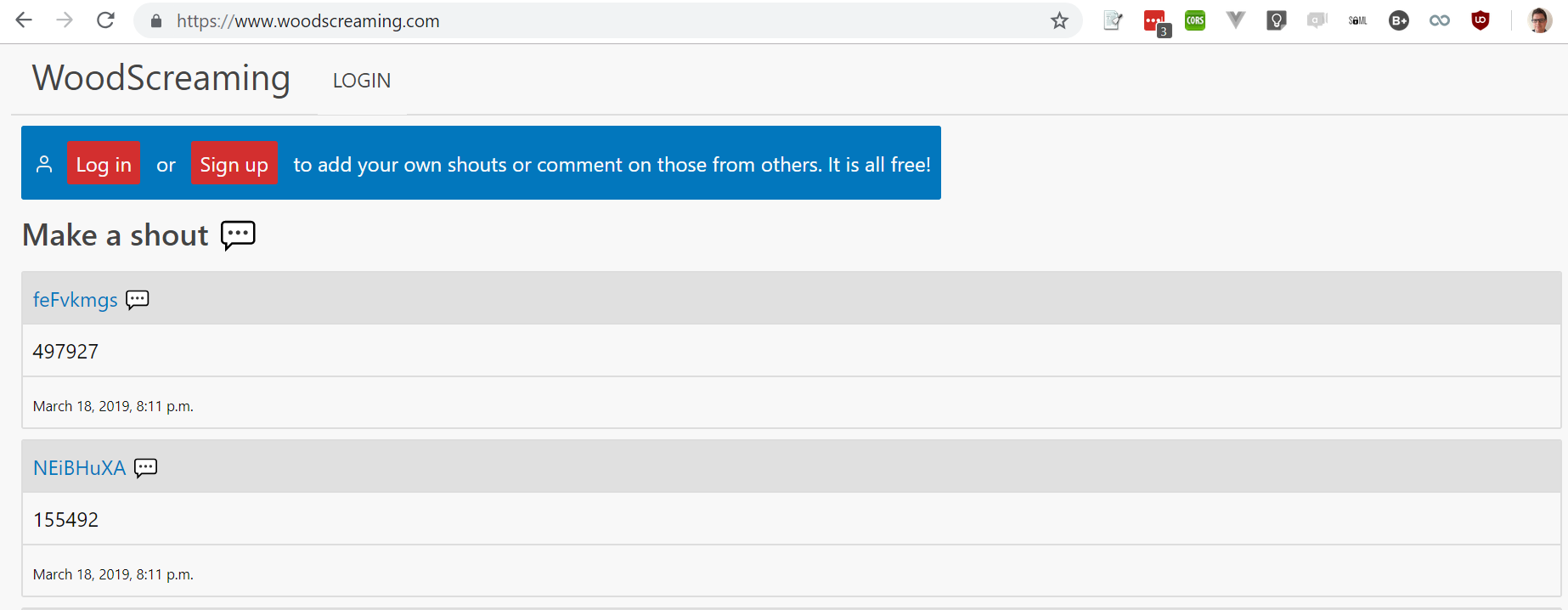
Just entering the URL http://www.woodscreaming.com and launching Burp to attack the application first goes through a crawl and audit of unauthenticated routes it can find (it basically clicks all the links it can find). Burp then registers a user, and starts probing the authenticated routes afterwards, including posting those weird numerical posts.

Woodscreaming.com: note the weird numerical posts. These are telltale signs of automated security testing with random input generation.

What scanners like Burp are usually good at finding, is obvious misconfigurations such as missing security headers, flags on cookies and so on. It did find some of these things in the woodscreaming.com page – but not many.

Waiting for security scanners can seem like it takes forever. Burp estimated some 25.000 days remaining after a while with the minimal http://www.woodscreaming.com page.

After runing for a while, Burp estimated that the remaining scan time was something like 25.000 days. I don’t know why this is the case (not seen this in other applications) but since a user can generate new URL paths simply by posting new content, a linear time estimation may easily diverge. A wild guess at what was going on. Because of this we just stopped the scan after some time as it was unlikely to discover new vulnerabilities after this.

The underlying application is a traditional server-driven MVC application running Django. Burp works well with applications like this and the default setup works better than it typically does for single page applications (SPA’s) that many web applications are today.

So, what did Burp find? Burp assigns a criticality to the vulnerabilities it finds. There were no “High” criticality vulns, but it reported some “Medium” ones.

Missing “Secure” flag on session cookies?

Burp reports 2 cookies that seem to be session cookies and that are missing the Secure flag. This means that these cookies would be set also if the application were to be accessed over an insecure connection (http instead of https), making a man-in-the-middle able to steal the session, or perform a cross-site request forgery attack (CSRF). This is a real find but the actual exposure is limited because the app is only served over https. It should nevertheless be fixed.

A side note on this: cookies are set by the Django framework in their default state, no configuration changes made. Hence, this is likely to be the case also on many other Django sites.

If we go to the “Low” category, there are several issues reported. These are typically harder to exploit, and will also be less likely to cause major breaches in terms of confidentiality, integrity and availability:

  • Client-side HTTP parameter pollution (reflected)
  • CSRF cookie without HTTPOnly flag set
  • Password field with autocomplete enabled
  • Strict transport security not enforced

The first one is perhaps the most interesting one.

HTTP paramter pollution: dangerous or not?

In this case the URL parameter reflected in an anchor tag’s href attribute is not interpreted by the application and thus cannot lead to bad things – but it could have been the case that get parameters had been interpreted in the backend, making it possible to have a person perform an unintended action in a request forgery attack. But in our case we say as the jargon file directs us: “It is not a but, it is a feature”!

So what about the “password field with autocomplete enabled”? This must be one of the most common alerts from auditing software today. This can lead to unintended disclosure of passwords and should be avoided. You’ll find the same on many well-known web pages – but that does not mean we shouldn’t try to avoid it. We’ll put it on the “fix list”.

Are automated tests useful?

Automated tests are useful but they are not the same as a full penetration test. They are good for:

  1. Basic configuration checks. This can typically be done entirely passively, no attack payloads needed.
  2. Identifying vulnerabilities. You will not find all, and you will get some false positives but this is useful.
  3. Learning about vulnerabilities: Burp has a very good documentation and good explanations for the vulnerabilities it finds.

If you add a few manual checks to the automated setup, perhaps in particular give it a site-map before starting a scan and testing inputs with fuzzing (which can also be done using Burp) you can get a relatively thorough security test done with a single tool.

Defending against OSINT in reconnaissance?

Hackers, whether they are cyber criminals trying to trick you into clicking a ransomware download link, or whether they are nation state intelligence operatives planning to gain access to your infrastructure, can improve their odds massively through proper target reconnaissance prior to any form of offensive engagement. Learn how you can review your footprint and make your organization harder to hack.

https://cybehave.no

Cybehave has an interesting post on OSINT and footprinting, and what approach companies can take to reduce the risk from this type of attack surface mapping: https://cybehave.no/2019/03/05/digital-footprint-how-can-you-defend-against-osint/ (disclaimer: written by me and I own 25% of this company).

tl;dr – straight to the to-do list

  • Don’t publish information with no business benefit and that will make you more vulnerable
  • Patch your vulnerabilities – both on the people and tech levels
  • Build a friendly environment for your people. Don’t let them struggle with issues alone.
  • Prepare for the worst (you can still hope for he best)

Storing seeds for multifactor authentication tokens

When setting up an application to use two-factor authentication for example with Google Authenticator, each user will have a unique seed value for the authenticator. The identity server will require knowledge of the seed to verify the token – meaning you will have to store it and retrieve it somehow. This means that if an attacker gets access to the storage solution that links OTP secret seeds to user ID’s (e.g. usernames), the protocol is broken. So, trying to think up some options for securing the secrets – we cannot hash and salt it because it breaks the OTP authentication flow. We are hence left with encrypting the seed before storing it.

The most practical seems to be a symmetric crypto approach, the question is what to use as the crypto key. Here are some approaches I’ve seen people discuss that all seem bad: 

  • User password: if you can phish the password, then you can also generate the OTP provided you know which algorithm/library is used
  • A static application secret: should be safe provided that secret is never leaked but using a static secret means that if it is compromised, all users are compromised. Still better than the user password, though. 
  • Using non-static user level meta data to create a unique key for each user that is not vulnerable to phishing or guessing. Typically visible to admins.
Get username/password
Verify username/password
Get OTP seed (encrypted)
Get metadata and reconstruct encryption key
Verify OTP
Authenticate user and store timestamp and other auth metadata
Construct new encryption key
Encrypt seed
Store in database

The question is what metadata to use. We need the following properties to be true:

  • Not possible to guess for a third party even if we tell what metadata it is
  • Not possible to reconstruct for an administrator with access to the account
  • Not possible to phish or obtain through social engineering or client side attacks

There are many possibilities but here is one possible solution that would satisfy all the above requirements:

Key = Password (Not available to admins) + Timestamp for last login (not guessable/phishable)

Deploying Django to app engine with Python 3.7 runtime – fails because it can’t find pip?

Update 1 June 2020: Google tells me the problem is now fixed. I haven’t verified it yet, will update if I find it is not fixed at the next crossroads. Bug tracker link: https://issuetracker.google.com/issues/131663964.

Update 30 March 2020: The problem is still here. Use pip version 19.2.3 now to make it work. Google: can you please go fix this now?

Update 30 April 2019: Problem is back. This time it tries to upgrade to pip 19.1, but the app engine instance is stuck on 19.0.3. Adding pip==19.0.3 in the requirements.txt file saves the deployment.

Update 1 April 2019: now the deploy fails with the same message as described in this post, when the PIP version is specified in the requirements.txt file. Removing the specific pip version line from the requirements file fixes this. I have not seen any change notice or similar from Google on this.

I had an interesting error that took quite some time to hunt down today. These are basically some notes on what caused it and how I tracked it down. I have an app that is deployed to Google App Engine standard. It is running Django and using the Python 3.7 runtime – and it was working quite well for some time. Then yesterday I was going to deploy an update (actually just adding some CSS tweaks), it failed, with a cryptic error message. Running “gcloud app deploy” lead to the following error message:

File upload done.
Updating service [default]…failed.
ERROR: (gcloud.app.deploy) Error Response: [9] Cloud build a33ff087-0f47-4f18-8654-********* status: FAILURE.
Error ID: B212CE0B.
Error type: InternalError.
Error message: pip_install_from_wheels had stderr output:
/env/bin/python3.7: No module named pip
error: pip_install_from_wheels returned code: 1.

This is weird: this is a normal Python project using a requirements.txt file for its dependencies. The file was generated using pip freeze, and should not contain anything weird (it doesn’t). Searching the wisdom of the internet reveals that nobody else seems to have this problem, and it only occurred since yesterday. My hunch was that they’ve changed something on the GAE environment that broke something. Searching the net gives us these options:

  • The requirements.txt file has weird encoding and contains Chinese signs/letters? That was not it.
  • This is because you need to install some special packages for using Python3.. was also not the case and would have been weird changing since a few days ago…
  • You need to manually install pip to make it work – which may be the case sometimes but without SSH access to the instance this isn’t obvious how to do.
The trick is often looking at the right logs….

So, being clueless I turned to looking for the right logs to figure out what is going on. Not being an expert on the GAE environment led to some hunting in the web console until I found “Cloud build”, which sounded promising. That was the right place to be – GAE uses a build process in the cloud to first build the application, and then a Docker image to push to the internal Google Cloud Docker repository. Hunting the build log for this finds this little piece of gold:

Step #1 - "builder": INFO pip_install_from_wheels took 0 seconds
Step #1 - "builder": INFO starting: pip_install_from_wheels
Step #1 - "builder": INFO pip_install_from_wheels /env/bin/python3.7 -m pip install --no-deps --prefix /tmp/tmp9Y3aD7/env /tmp/tmppuvw4s/wheel/pip-19.0.1-py2.py3-none-any.whl --disable-pip-version-check
Step #1 - "builder": INFO `pip_install_from_wheels` stdout:
Step #1 - "builder": Processing /tmp/tmppuvw4s/wheel/pip-19.0.1-py2.py3-none-any.whl
Step #1 - "builder": Installing collected packages: pip
Step #1 - "builder": Found existing installation: pip 18.1
Step #1 - "builder": Uninstalling pip-18.1:
Step #1 - "builder": Successfully uninstalled pip-18.1
Step #1 - "builder": Successfully installed pip-19.0.1
Step #1 - "builder": Failed. No module /env/python/pip

Before the weird error we see it is trying to uninstall pip-18.1, then install pip-19.0.1 (a more recent version), and then it can’t find pip afterwards and the build process fails. This has not been configured by me and is probably Google configuring automatic upgrades of some packages during build – and here it breaks the workflow.

Fixing it

The temporary fix was simple. Adding “pip==18.1” to the requirements.txt file, allowed the build process to run and it deployed nicely.

What did we learn from this?

  • API tools give only partial error messages, making debugging hard.
  • Automated upgrade configs are good but can cause things to break in unforeseen ways.
  • Finding the right logs is the key to fixing weird problems

Combining VueJS and Django to build forms with custom widgets

This post is brief and explains a pattern that may be dangerous but still is very handy for combining VueJS with Django templates for dynamic forms. Here’s the case: I need to build a form for sending out some messages. One of the form widgets is a <select> tag where each <option> is a model instance from Django. The widget will then show the name of that model instance in the UI, but this does not provide enough context to be useful, we also need some description text. There are basically two options for how to handle this:

  1. Use the form “as-is” but provide the extra context in the UI by pulling some extra information and building an information box in the UI.
  2. Create a custom widget, and bind it to the Django model form using a hidden field.

Both are probably equally good, but I went with the second option. So here’s what I did:

  1. Build a normal Django model form, but change the widget for the field in question to type “HiddenInput” in the form.py file.
  2. Build a selector widget using VueJS that allows the user to get the desired content and review the various options with full context (including images and videos, things you can’t put inside a dropdown list. We are binding the selected choices to frontend data using the v-model directive in VueJS.
  3. Set the hidden field to set its value based on the data value stored in the frontend using that v-model directive
  4. Process the form as you normally would with a Django model form.

The form definition remains very simple. Here’s the relevant class from this example:

class MailForm(forms.ModelForm):

    class Meta:
        model = Campaign
        fields = ('name','to','elearning',)
        widgets = {
            'elearning': forms.HiddenInput(attrs={':value': 'module.pk'})
        }

The selector widget can take any form you could desire. The point in this project was to show some more context for the “eLearning” model. The user here gets notification about enrollment in an eLearning module by e-mail. The administrator setting up the program needs to get a bit of context about that e-learning, such as the name of the module, a description of its content, and perhaps a preview of a video or other multimedia. Below is an example of a simple widget of this type. The course administrator can here browse through the various options by clicking next, and the e-mail form is automatically updated.

Of course, to do that binding we need a bit of JavaScript in the Django template. We need to perform the following tasks to make our custom widget work:

  1. Fetch information about all the options from the server. We need to create an API endpoint for this, that can deliver JSON data to the frontend.
  2. Set the data item bound to the Django form based on the user’s current selection

Now the form can be submitted and processed using the normal Django framework patterns – but with a much more context-rich selection widget than a simple dropdown list.

Is it safe to do this?

Combining frontend and server-side rendering with different templates for HTML rendering can be dangerous. See this excellent write-up on XSS vulnerabilities that can be the result from such combinations: https://github.com/dotboris/vuejs-serverside-template-xss.

This is a problem when user input is injected via the server-side template as the user can supply the interpolation tags as part of the input. In our case there is no user input in those combinations. However, if you need to take user input and rerender this using the server-side templates of some framework like Django, here are some things you can do to harden against this threat:

  • Use the v-pre directive in VueJS
  • Sanitize the input to discard unsafe characters, including VueJS delimiters
  • Escape generated output from the database to avoid injections making it as executable JavaScript reaching the user’s context

Security awareness: the tale of the Minister of Fisheries and his love of an Iranian former beauty queen

An interesting story worthy of inspiring books and TV shows is unfolding in Norway. The Minister of Fisheries, Per Sandberg (born 1960), from the Progress Party (a populist right party), spent his summer holiday in Iran together with his new girlfriend, a 28-year old former beauty queen who fled to Norway do escape forced marriage when she was 16. The minister brought his smartphone, where he has access to classified information systems. He forgot to inform the prime minister before after he left, a breach of security protocol. He ignored security advice from the Norwegian security police, responsible for national security issues and counter-intelligence. He is still a member of the cabinet. This post is an attempt at making sense of this, and what the actual risk is. A lot of people in Norway have had their say in media about this case, both knowledgeable voices, and less reasonable ones.

Some context: Norwegian-Iranian relations

Traditionally there has been little trade between Iran and Norway. Recently, following the nuclear agreement between Iran and the US, UK, France, China, Russia and Germany this has started to change. Norway has seen significant potential for exports to Iran of fish and aquaculture technologies. In the last year or so, Minister Sandberg has been central to this development (see timeline further down on Sandberg’s known touch points with Iran).

In the Norwegian public skepticism of the Iranian regime is high, and there has been vocal criticism of establishing trade relationships over human rights concern.

The Norwegian Iranian interest spheres are also intersecting in the Middle East. Iran has established tighter relations with Russia since 2016 when it started to allow Russian bombers to take off from Iranian air force bases for bombing missions inside Syria. The Norwegian-Russian relations are strained, following the response of NATO and the EU to Russian operations in the Ukraine, influencing of western elections and a general intensification of cyber operations against Norwegian targets (see open threat assessment from Norwegian military intelligence: https://forsvaret.no/fakta/undersokelser-og-rapporter/fokus2018/rapport (in Norw.). Operations against Norwegian government officials by Iranian services may thus also be driven by other interests of Iran than direct Norwegian-Iranian relations.

Sandberg: who is he and what could make him a viable target for intelligence operations?

This is a presentation of Sandberg taken from the web page of the Ministry of Trade, Industry and Fisheries (https://www.regjeringen.no/no/dep/nfd/organisation/y-per-sandberg/id2467677/). Note that his marital status is “married” – but he separated from his wife in May 2018. Sandberg is a vocal figure in Norwegian politics. He has been known to be against immigration and a supporter of strict immigration laws. He has repeatedly been accused of racism, especially by the opposition. He has long held top positions in the Progress Party, which has been a part of a coalition cabinet together with the conservatives (Høyre), and more recently also with the moderately liberalist party “Venstre” (meaning left but it is not a socialist party). Sandberg is known for multiple controversies, summarized on this Wikipedia page: https://en.wikipedia.org/wiki/Per_Sandberg#Controversies. This involves addressing the parliament after having too much to drink, losing his driver’s license due to speeding and finally he was also convicted for violence against an asylum seeker in 1997.

Sandberg has been married since 2010 to 2018 to Line Miriam Sandberg, who has been working as a state secretary for the Ministry of Health since 2017. They recently separated.

His new girlfriend

Sandbergs new girlfriend came to Norway when she was 16 (or 13/14 the first time according to some sources) to flee forced marriage to a 60-year old man in Iran. She is now a Norwegian citizen and is 28 years old. She has participated in several beauty contests in 2013-2014. After she first came to Norway, she was not granted asylum and returned to Iran. Iran sent her back to Norway again because she did not have any identification papers when arriving, and she was adopted by a Norwegian family. A summary of known facts about Letnes and how she gained access to Iran after being returned to Norway without ID papers when she was a teenager was written in Norwegian by Mahmod Fahramand (https://www.nettavisen.no/meninger/farahmand/per-sandbergs-utfordring/3423519653.html). Farahmand is currently a consultant with the auditing and consulting firm BDO and has background from the Norwegian armed forces. He often writes opinion pieces about security related topics. To summarize some of Farahmand’s points.

  • Letnes was returned to Norway and was later adopted by her foster family
  • She has been a “go-to-person” for journalists wanting to get in touch with Iranian officials and has been known to have close relationships with the Iranian embassy in Oslo
  • Iran does not allow Iranian-born indivdiuals to enter Iran without an Iranian passport. If they do not have this, they will need to get access to their birth certificate or otherwise prove to the Iranian government that they in fact have a right to an Iranian passport. Since Letnes fled Iran to seek protection from the threat of her family, it seems she must have gotten access to this without contacting her family, Farahmand argues.

Letnes had her application for asylum turned down 3 times before getting it approve. The reason for the change of the decision of the immigration authorities in 2008 is not known (Norw: https://www.nrk.no/trondelag/–jeg-er-kjempeglad-1.6236578). In addition, it has become known in media in the last few days that Letnes applied for a job with Sandberg’s ministry, suggesting she could act as a translator and guide for Sandberg’s communications with Iran in matters related to fishery and aquaculture trade, which she did not get. Sandberg denied any knowledge of this prior to media inquiring about it. The job application was sent in 2016. She also registered a sole proprietorship in January this year, B & H GENERAL TRADING COMPANY. BAHAREH LETNES, a company to trade with Iran in fish, natural gas, oil and technology (corporate registration information: https://w2.brreg.no/enhet/sok/detalj.jsp?orgnr=920188095). The company has according to Letnes not had any activity so far, according to media reports.

A honeytrap? Possibly. A security breach? For sure.

The arguments from Farahmand’s article above, together with the fact that Letnes tried to get a job for Sandberg in 2016, could easily indicate that Letnes sought to get close to Sandberg. She has sought multiple touchpoints with him since he was appointed Minister of Fisheries in 2015.

This would be a classical honeytrap, although a relatively public one. Sandberg has failed to follow security protocol on many occasions in his dealings with Letnes and Iran. Obvious signs of poor security awareness on behalf of the Minister:

  • He brought his government issued cell phone to Iran and left it unattended for longer periods of time where they stayed at the time
  • He did not tell the office of the Prime Minister about his travel to Iran before leaving. This is a breach of security protocol for Norwegian ministers
  • His separation from his wife became known in May this year
  • He has announced his “original vacation plans got smashed, so the trip to Iran was a last-minute decision”. He was supposed to go on holiday to Turkey, which he had also reported to his Ministry and the office of the Prime Minister, in accordance with security protocol (Norw: https://www.aftenposten.no/norge/politikk/i/e1xzJO/Fiskeriminister-Per-Sandberg-bekrefter-at-han-reiste-til-Iran-uten-a-informere-departementet-eller-statsministeren )
  • The Norwegian government was made aware of Sandberg’s presence in Iran when they received an e-mail from the Iranian embassy in Oslo, requesting official meetings with Minister Sandberg while he was in Iran

Iranian TTP

According to Kjell Grandhagen, former head of Norwegian military intelligence, Iran has a very capable and modern intelligence organization. He holds it as highly likely that Sandberg’s government issued phone, which he left unattended a lot of the time while in Iran, has been hacked (https://www.digi.no/artikler/tidligere-sjef-for-e-tjenesten-tror-per-sandbergs-mobil-har-blitt-hacket/442930). According to this CSO summary, Iran has serious capabilities within both HUMINT and cyber domains. Considering the known cyber capabilities of Iran, and the looming sanctions from the Trump administration, getting both information and leverage over a key politician in a NATO country becomes even more interesting, not only to Iran but also to Russia.

Coming back to Iran’s more recent tighter cooperation with Russia, it is not unlikely that they are also initiating a closer relationship when it comes to intelligence gathering. The use of honey traps has been a long-standing Russian tactic for information gathering and getting leverage over decision makers. In 2015, Norwegian police warned against Russian intelligence operations targeting politicians, including the use of honey traps (https://finance.yahoo.com/news/norwegian-police-warning-citizens-against-195510994.html).

A summary: why is he still in office?

The facts and arguments presented above should indicate two things very clearly:

  • Based on publicly known information, it is clearly possible that Iranian intelligence is targeting Per Sandberg. They may have an asset close to him, as well as having had physical access to his smartphone that has direct access to classified information systems.
  • Further, Sandberg has broken established security protocol, and although admitting this, he does not seem to appreciate the potential impact

The effect of a top leader not taking security seriously is very unfortunate. Good security awareness in an organization depends heavily on the visible actions of its people at the top – in business as well as in politics. A breach of security policy without getting any personal consequences on this level sends a very poor message to other politicians and government officials. It also sends a message to adversaries that targeting top-level politicians is likely to work, even if there are numerous indicators of a security breach. There should be no other possible conclusion of this than relieving Mr. Sandberg of his position – which would set him free to further develop his relationship with the Iranian beauty queen.

Making Django, Elastic Beanstalk and AWS RDS play well together

A couple of days ago I decided I should learn a bit more hands-on AWS stuff. So I created a free tier AWS account, and looked around. I decided I’d take a common use case; deploy a web application to Elastic Beanstalk and add a domain and SSL.

Setting up tools

Step 1: reading documentation. AWS has a lot of documentation, and it is mostly written in a friendly manner with easy-to-follow instructions. Based on the documentation I opted for using the command line Elastic Beanstalk tool. To use this you need Python and pip. You can install it with the command

pip install awsebcli –upgrade

If you are having a permissions problem with doing this, you can throw in a “–user” flag at the end of that command. This will install the tool you need to create and manage EB environments from your command line. Since it is a Python utility it works on Windows, as well as Mac and Linux. Installing this did not pose any hiccups. You can read more about how to set this tool up and updating your system path here: https://docs.aws.amazon.com/elasticbeanstalk/latest/dg/eb-cli3-install.html.

Before using it you need to set it up. Issue the command

eb init.

This will give you a prompt asking for a number of things, like region to set up in, etc.

Learning point: if you want to set up a database, such as MySQL in the EB environment, you should use the database option when issuing the next command. Anyway to set up your environment, use

eb create https://docs.aws.amazon.com/elasticbeanstalk/latest/dg/eb3-create.html

If you want a database in your environment add the –db flag with the desired options; you cannot create the database in the EB Console (web-based interface) afterwards, at least not for micro instances that are allowed in the free tier. According to someone on Stack Overflow, this is a bug in AWS that you can wait for them to fix – or use the command line option (supposedly that works but it is not what I did).

If you create a database in your EB environment, your DB will be terminated too if you terminate that environment. You may not want that, so you can consider setting up an external database and connecting to it outside of EB. That is what I did, and there’s more about that a little further down this post.

Creating a Django app

To have something to deploy I created a Django app. This is an asocial network; you can post things with links and hashtags but you can’t follow other users or anything like that. It has user management and uses the default Django admin system and authentication system (session based). I called it woodscreaming and you can view it here: woodscreaming.com.

Setting up a virtual environment

First, to avoid mixing up things and creating a requirements file that works, create a virtual environment. For this I like to use the tool virtualenv (works on all platforms, can be installed with pip if you don’t have it):

virtualenv –python=python venv

“venv” is the name of your virtual environment. Everything you install when the environment is active will be contained in that environment, and you have all dependencies under control (think of it like a semi-container-solution). To activate the environment on Linux/Mac:

source venv/bin/activate

On Windows:

venv\Script\activate

When you have all the dependencies your app needs in place, run

pip freeze > requrements.txt

This creates a requirements.txt file that EB will use to install your app in the cloud.

Adding EB configuration files to the Django project

To make things work, you also need to add some EB specific configuration files to your Django project. Create a folder named .ebextensions in your project’s root folder. In this folder you will need to add a django.config file with the following contents:

option_settings:
  aws:elasticbeanstalk:container:python:
    WSGIPath: projectname/wsgi.py

Of course you need to change the word projectname into the name of your project. This tells EB where to find your wsgi file. This file describes how the web server should be set up and is a Python standard.

You should also tell EB to run migrations to get your data models to work with your database. Adding a file (I called it db-migrate.config) to the .ebextensions folder fixes this. Here’s what you need to add to that file:

container_commands:
  01_migrate:
    command: "django-admin.py migrate"
    leader_only: true
option_settings:
  aws:elasticbeanstalk:application:environment:
    DJANGO_SETTINGS_MODULE: discproject.settings

You should also create a folder called .elasticbeanstalk. The command line client will populate this with a YAML file called config.yml tha tells EB what resources are needed (you don’t need to edit this file yourself).

That’s it to begin with – some changes need to be made when adding an RDS database and setting up http to https forwarding.

Deploying to EB

Deploying to EB is very easy, you simply deactivate your virtual environment by issuing the command “deactivate” and then you run

eb deploy

It now zips your source, uploads it to AWS and installs it and provisions the resources defined in your config.yml file. It takes a while, and then it is done. Then you can see your web app online by issuing the command

eb open

The app will get its own URL automatically, of the format “something.aws-region.elasticbeanstalk.com”. It does not get an SSL certificate (https) automatically – you will need to set up a custom domain for that (more about that later). Anyway, opening it up shows the web app running in the cloud and I am able to use it.

Dev database vs prod database

By default django-admin.py sets up a project hat uses an SQLite database; a single file SQL database that is popular for persistent storage in mobile apps and embedded applications. When deploying your development environment’s database is deployed too, and with each redeploy you will overwrite it. It is not great for concurrent operations, and obviously overwriting all user data on each deploy is not going to work. There are ways around this if you want to stick to SQLite but that is normally not the best solution for a web app database (although it is great for development).

Next we look at how we can create a database in the cloud and use that with our production environment, while using the SQLite one in local development.

Adding an RDS database

Attempt 1: Using the EB Console

In the EB console (the web interface), if you go to “Configuration”, there is a card for “Database” and an option to “modify”. There you can set up your desired database instance and select apply. The problem is… it doesn’t work for some reason. The deployment fails due to some permission error. I’m sure it is possible to fix but I didn’t bother fiddling enough with it to do that. And as mentioned above; if you terminate the environment you will also terminate the database.

Attempt 2: Setting up and RDS database external to EB

This worked. Basically following AWS documentation on how to set it up was quick and easy:

  • Go to RDS, create a new instance. Select the type of database engine, EC2 instance type etc.
  • Select db name, username, password (remember to write those down – I use secure notes in LastPass for things like this). Set the DB instance to be “public” to allow queries from outside your VPC to reach it.
  • Add the RDS security group to your EB EC2 instance. This is important – if you do not do this, it is not possible to query the database from EB.

To add that security group in EB you need to go to the EB console, head to configuration and then select the card for instances. Select “modify” and then head to the security groups table – add the RDS one (it is automatically generated and named something like rds-default-1) and click apply. Because the database is external to EB you also need to add environment variables for the connection. To do this, head to the console again and select “modify” on the software card. Add the following environment variables:

  • RDS_DB_NAME
  • RDS_HOST_NAME
  • RDS_PORT
  • RDS_USERNAME
  • RDS_PASSWORD

The values are found in your RDS instance overview (head to the RDS console, select your instance, and you find the variables a bit down on the page). Now, you also need to tell your Python app to read and use these. Add this to your Django settings file:

if 'RDS_HOSTNAME' in os.environ:
    DATABASES = {
        'default': {
            'ENGINE': 'django.db.backends.mysql',
            'NAME': os.environ['RDS_DB_NAME'],
            'USER': os.environ['RDS_USERNAME'],
            'PASSWORD': os.environ['RDS_PASSWORD'],
            'HOST': os.environ['RDS_HOSTNAME'],
            'PORT': os.environ['RDS_PORT'],
        }
    }
else:
    DATABASES = {
        'default': {
        'ENGINE': 'django.db.backends.sqlite3',
        'NAME': os.path.join(BASE_DIR, 'dbp.sqlite3'),
        }
    }

After doing this the EB environment health was showing as “green” and all good. But my web app did not show up and the log showed database connection errors. The solution to that was: read the docs. You also need to add the RDS default security group (the one that allows inbound connections) to the allowed sources for inbound connections. Details here: https://docs.aws.amazon.com/elasticbeanstalk/latest/dg/AWSHowTo.RDS.html. After doing this – it works!

Adding a Django superuser to the RDS database

You could SSH into your EC2 instance running the Django app and use the manage.py utility; but this kind of beats the point of having a PaaS that supposedly should be able to configure things without SSH-ing into everything.

To add a Django superuser you should thus add a new Django command to your environment. Here’s a good description of how to do that: https://github.com/codingforentrepreneurs/Guides/blob/master/all/elastic_beanstalk_django.md. You can add the command to your db-migrate.config file in the .ebextensions folder.

Configuring DNS with Route 53

Now, having the default URL is no fun, and you can’t add SSL on that one. So we need to set up DNS. I chose to buy a domain name from Amazon and then set up DNS with Route 53. Setting that up for an EB environment is super-easy: you make an A record as alias to your EB environment URL.

Adding an SSL certificate that terminates on the load balancer

Now that we have a working domain name, and we’ve set up the DNS records we need, we can add an SSL certificate. The easiest way to provision the certificate is to use Amazons certificate management service. You provision one for your domain, and you can verify by adding a CNAME record to your DNS hosted zone in Route 53.

The next thing you need to do to make things work is add the certificate to your Elastic Beanstalk environment. Depending on your threat model and your needs, you can choose the simple route of terminating https on the load balancer (good enough for most cases), or you can set up AWS to also use secure protocols in internal traffic (behind the load balancer). I chose to terminate traffic on the load balancer.

The AWS docs explains how to do this by adding a secure listener on the load balancer: https://docs.aws.amazon.com/elasticbeanstalk/latest/dg/configuring-https-elb.html.

Forwarding http to https

To forward http traffic to https there are several ways this can be done. The easiest is to set up forwarding on the Apache server. Since we are not using SSH to fiddle with the server directly, we do this by adding a configuration file to our .ebextensions folder in the Django project, and then redeploying. Adding a file https.config with the following contents does the job:

files:
    "/etc/httpd/conf.d/ssl_rewrite.conf":
        mode: "000644"
        owner: root
        group: root
        content: |
            RewriteEngine On
            <If "-n '%{HTTP:X-Forwarded-Proto}' && %{HTTP:X-Forwarded-Proto} != 'https'">
            RewriteRule (.*) https://%{HTTP_HOST}%{REQUEST_URI} [R,L]
            </If>

Summary

This post is a walk-through of getting the essentials done to use Elastic Beanstalk to serve a web application:

  • Create an environment and deploy an app
  • Use config files to manage server processes and configurations
  • Setting up an external RDS database and connect to it using environment variables
  • Configuring a custom domain name and setting up DNS
  • Adding SSL termination on the load balancer
  • Adding a http to https rewrite rule to Apache on the web server using a config file


How a desire for control can hurt your security performance

Lately we have seen a lot of focus on security in social media – professionals, companies, organizations trying to increase security awareness. A lot of the information out there is about “control” and “compliance”. The downside of a risk management regime based on strict rules, controls and compliance measures has been demonstrated again and again throughout history, and I’ve also written about it before in terms of getting users on board with the security program. My background is from the oil and gas industry – an industry that has seen several horrific accidents. Two of the more well-known and dramatic ones are the Piper Alpha accident 30 years ago this year, and the Deepwater Horizon blowout in 2010. In both of these cases, investigations pointing to “root causes” concluded with a degraded safety culture, lack of attention to real risks and partially blamed a prescriptive approach to safety. The same arguments are equally valid for security incidents. The goal should be to find a balance between security and operational flow.

acrobatics action balance ballet
Balancing security against performance is necessary to operate with flow and still be at trusted business partner.

Some examples of potentially unhelpful helpfulness

If you are looking for security advice online, it is easy to find. A lot of it will tell you to “trust nobody, lock down everything”. From a traditional security point of view this makes sense – but it does not take the risk context into picture, nor does it balance measures against operational needs (such as keeping your store open, or being able to try new things to innovate and create new products).

Here’s Dr. Eric Cole (he knows a lot about security but sometimes I think his advice is a bit draconian)

Change control is important – but gathering a “change control board” for every change you do may be overkill – if you want ot stay “agile” and able to respond to changing demands.

Another common “rule” that actually does make a lot of sense is not to give end-users admin rights to their work computers. But…. needs will vary. If you are trying to develop new technology but your developers have to go through a lot of red-tape to try out a new technology, it will certainly have some ill effects on your teams ability to innovate. On the other hand, giving developers all free reigns in the name of the “sacred innovation gods” is also not a very good idea. The whole thing is about balance.

Risk acceptance and balance

Security controls are often cumbersome for people. Airport security, nightclub bouncers, two-factor authentication, no admin rights. Security leads to limitation of access in a large number of cases. This obviously has a downside when it comes to how fast we can innovate, how quickly we can produce. The benefit is reduced probability and impact of a major incident – and such incidents are very expensive. The amount of security cumbersomeness people are willing to accept and live with will normally depend on how bad it can get if someone hacks you. If your system controls nuclear weapons, a power plant, or perhaps the production at a chemical plant, incidents can cause real disasters leading to financial and environmental ruin, as well as a large number of fatalities. In this case, you will probably accept a lot of security controls to minimize the chance of something like that happening.

On the other hand, if you are selling some new hot service online, you still need people to trust your service, and you need to comply with privacy laws. This means your security must still be good – but you may nevertheless adopt a slightly higher risk acceptance than in the nuclear weapons case.

The trick is to find a good balance between acceptable risk performance, and good operational flow. This in itself will contribute to greater security performance overall, as the human factor side to cyber risk is very large, something that is often undervalued when designing security controls. To do this in a coherent manner we bring you the mighty tool of the…. risk based threat model.

Threat models for a balanced security strategy

A threat model is best made for a specific system or subsystem. The system can be everything from “the company network” to a specific application or a small software component. The thinking remains the same but the details in your model will change. The whole purpose of it is to understand how and Adversary can perform an Action on a Target to achieve an Objective. There are many ways to model this explained in the literature, but we won’t go into details about them here. If you want the details you can search for attack trees, STRIDE, cyber kill chain.

Context. You need to understand 3 things about the risk context:

  • Who are the stakeholders and what is their interest in the system? Owners, employees, users, customers, suppliers, attackers, insiders
  • What does the system itself do?
  • Who are the threat actors? Use threat intelligence to understand how adversaries approach the system and the supply chain you are a part of.

Inventory and data flow. Create a data flow diagram on the architectural level. Include relevant information such as protocols and main technologies. Describe what each asset is used for, and make a list of what data is being processed and transferred. Make trust boundaries visible in your diagram. For the inventory, consider the potential impact of confidentiality, integrity or availability losses.

Abuse cases. Consider how the various processes and data transfer operations can be abused by an adversary with sufficient access. Access can be physical access, stolen credentials, through malware or direct use of software vulnerabilities. The abuse case is your primary tool for understanding how controls can stop the adversary’s actions.

Detection and mitigation. Your system is probably not wide open to attack. List the most important controls you have in place already. The main purpose of this is to check if you are missing something obvious that you probably should be doing to stop attacks.

Evaluate and prioritize. Evaluate the threats according to the estimated risk. Prioritize controls that will help you reduce the risk of unacceptable actions being taken by adversaries to your most important assets and operational capabilities. Make sure you do not over-stretch the organization’s capabilities – focus on what matters the most first.

Thinking through your context and what you value brings you a long way alone, in particular with solid baseline controls. Maintaining a threat model that is kept up to date regularly with new threat intelligence and other context changes also allows you to ensure you do not fall behind how the world moves. Taking risks is fine, but know what risks you can afford to take – when you do that, you can choose the point for balancing security and performance.